21 November 2026
Adult Beginner Skiing: How to Start and Where to Learn

An adult beginner is best served by a resort that sells a bundled first-timer package (lesson, rental gear and a beginner-area lift ticket), has gentle green terrain, and sits close enough that travel does not eat the first morning. Most adults can ski green runs after one to three days of lessons, and a plan built around three to five lessons holds up better than a single day. Matching the resort, the lesson format and the budget to the group is the step that decides whether the trip feels easy. That matching is what BergMe’s questionnaire is built for: it filters out resorts that do not fit a group’s level, style and preferences and ranks the rest, with no registration or email required.
TL;DR
- Adults learn well: the main difference from children is fear of falling and speed, offset by the ability to analyze and repeat movements. The rule is not to rush.
- Plan three to five lessons before leaving the beginner slope. A first lesson covers gear, stance, the wedge stop, first turns, the magic carpet and falling safely.
- First-timer packages in 2026/27 range from $109 for one day to $299 for four lessons at US resorts, with lessons, rentals and lift access included.
- Resort choice matters as much as the lesson: look for a calm learning area, genuinely easy runs after it, and short, simple lift routes.
- A questionnaire-based match saves the comparison work for families, couples and groups with mixed ability.
Table of Contents
- Can adults learn to ski?
- What a first lesson covers
- Group, private or semi-private lessons
- What beginner packages cost in 2026/27
- How to choose a resort for learning
- Gear: rent first, buy later
- Safety basics for a first trip
- Planning for families, couples and groups
- Where BergMe fits
- Find a beginner-friendly trip
- A simple plan for a first ski trip
- FAQ
- Sources
Can adults learn to ski?
Yes, and the starting age has a wide range. A resort guide from Les Gets says adults at 25, 35, 45 or later can learn, and that the first sessions concentrate on equipment, balance, speed control and stopping with the snowplow (also called the wedge: skis angled into a V to slow down). Turns and a gradual move from practice areas to green runs follow.

The same guide describes what separates adults from children. Adults carry more risk awareness, so fear of falling and of speed is the main obstacle. Their advantages are technical understanding, the ability to analyze sensations and to replicate movements consciously. The practical conclusion is a slow progression.
Learning to ski at 60 or older
Age 60 is not a barrier. Tree Line Review’s reporting on older skiers, No Age Limit: Skiing at 60 and Beyond, stresses consistency over intensity. One skier it describes skis daily in winter and runs daily in summer so that she does not have to break herself in each season. For very late starters the key is terrain: flat tracks where gliding and socializing carry no pressure. Anyone with a medical condition should confirm with their own doctor that downhill skiing is suitable before booking.
What a first lesson covers
Beginner lessons follow a similar order at most resorts. A guide to adult ski lessons lists a gear check, stance, wedge stopping and turns, magic-carpet then chairlift riding, and falling and getting up safely. A magic carpet is a moving conveyor belt that carries beginners up a gentle slope without a chairlift.
A typical session runs in this sequence:
- Equipment familiarization. Boots buckled, skis on, a feel for how the binding releases.
- Flat-ground gliding. Standing, walking and sliding on one ski, then both, with no slope at all.
- Climbing a gentle incline. A duck-walk (toes pointing outward) or side-step up a few meters.
- The snowplow stop. Speed control comes before turning.
- First turns. Shifting weight to steer the skis across the gentle slope.
- Lift use. The magic carpet first; the chairlift once stopping and turning are reliable.
The order is consistent across sources. New Generation’s first-lesson walkthrough describes the same flat-ground, incline, snowplow, turn progression and advises practice and rest afterward.
How many lessons it takes
Results vary, but the published ranges are close. The snowway guide above says most adults can ski green runs within one to three days of lessons. Home Mountain Ski Club’s adult learning guide advises planning at least three to five lessons before anything beyond a gentle beginner slope. Its reasoning: progressing too fast is the most common reason adult beginners lose confidence and quit.
For trip planning, this means a single day is a taste and a multi-day package is a start. Trips of three to four days with a lesson each morning and free practice in the afternoon fit the evidence better than a weekend with one two-hour class.
Group, private or semi-private lessons
REI’s first-time skiing guide states that group lessons are generally the best deal, while private lessons cost more but give individual attention and more control over pace. The choice usually follows the group:
| Lesson type | Best for | Main advantage | Main cost factor |
|---|---|---|---|
| Group | Solo adults, couples at the same level | Lowest price per person | Fixed pace, shared attention |
| Private | Anxious beginners, mixed-ability groups, older learners | Pace set by the learner | Highest hourly rate |
| Family or semi-private | Parents and children, friends of similar level | Shared instructor cost | Availability varies by resort |
Couples at different levels often do better with separate group lessons in the morning and a shared easy run in the afternoon than with one private lesson for both. A private lesson also suits an adult who wants to avoid learning in front of a class, which is a common worry.
What beginner packages cost in 2026/27
Many resorts bundle the three items a beginner needs: a lesson, rental equipment and lift access to the learning area. REI advises checking that a package includes what is needed, since lesson programs differ. Three published US examples for the 2026/27 season show the range:
| Program | Price | What is included | Conditions |
|---|---|---|---|
| Whitefish Mountain Resort, First Time Lesson Package | $109 (adult, ages 13+) | One day of lessons, rental equipment, beginner-area lift ticket | Subject to availability |
| Red Lodge Mountain, Learn 4 Life | $299 | Four lessons, four lift tickets, four rentals | Lessons completed by February 28, 2027; blackout dates apply |
| Indy Pass, Learn To Turn Pass | $189 | Three beginner days, each with a lesson, rental equipment and beginner-terrain access | Participating areas in the US and Canada; reservations and blackout dates may apply |
Per day, the multi-day options are cheaper: $189 over three days works out to $63 a day, and $299 over four days to $74.75. The one-day price is lower in total but pays for a single session, which the sources above suggest is not enough for most adults to reach green runs comfortably. Prices, blackout dates and eligibility change each season, so the resort’s own page is the reference before booking.
Local hill or destination resort
SkiTutor’s first-lesson guide describes the trade-off. Destination resorts usually have higher-caliber instructors but cost more, and one day of private lessons at a destination resort can cover three or more days at a local hill. That makes a local hill a budget-friendly way to test the sport. REI adds that a smaller, lesser-known resort can save money and that a closer resort allows a more relaxed start to the day.
For a trip that is also a vacation, the cost picture extends past the lesson: lodging, food and travel often outweigh the lesson fee. For readers weighing the whole budget, a guide on planning a trip under $500 covers how to balance lodging, transport and activities against a fixed amount.
How to choose a resort for learning
Ski area size and the number of advanced runs say little about a first week. Skier & Snowboarder Magazine’s resort-selection article advises beginners to look beyond a nursery slope for a calm learning area, a reliable ski school and genuinely easy terrain for progression. It warns that long drag lifts, choke points and steep run-outs make learning harder.
A workable checklist:
- Separate learning area. A fenced or distinct zone with a magic carpet keeps beginners out of through traffic.
- Green runs that connect. After the nursery area, at least one long, wide green run served by a straightforward lift.
- Easy lift routes. Few transfers, no long drag lifts, and an easy way back to the base.
- Ski school reputation and format. Half-day and full-day options, adult-only classes, and a stated policy for anxious beginners.
- Bundled pricing. A package that includes rentals and the learning-area lift ticket.
- Travel time and lodging. Distance from the airport or home, and whether lodging sits near the base.
Trail ratings are not standard across resorts. REI notes that ratings can vary between resorts, so a green run at one mountain may be steeper than at another. Reading a trail map with the school’s advice at hand helps.
Timing the first lesson
SkiTutor recommends a morning first lesson, when slopes are less crowded and snow is fresh. It also notes that beginner terrain is often the first to open each season, so early-season visits let a beginner start as soon as slopes open and use more of the winter.
Gear: rent first, buy later
For a first trip, REI recommends renting fitted equipment rather than buying. Rental shops at most resorts supply skis, boots and often helmets; New Generation’s list of items to bring covers the lift pass, helmet, goggles, ski wear and gloves, with poles optional. Packages that bundle rentals remove the question altogether. Waterproof gloves, goggles and layered clothing are the items worth arranging in advance, since cold hands end more first days than any technical problem.

Safety basics for a first trip
Three points apply to every adult beginner.
Follow the skier responsibility code. The National Ski Areas Association’s Your Responsibility Code states that people ahead of or downhill of a skier have the right of way and must be avoided, and that skiers should stop only where they are visible from above and do not restrict traffic. Staying in control is the central rule.
Check insurance before traveling. For readers traveling abroad, the UK government’s winter sports guidance notes that many policies exclude off-piste skiing without a guide and damage to rental equipment, and some require helmet use. It also advises reading piste maps and difficulty classifications and checking snow, weather and avalanche reports. US travelers should read their own medical and travel policy for the same exclusions.
Skip alcohol before skiing. The same guidance warns that alcohol at altitude impairs judgment and can invalidate insurance cover if an intoxicated skier injures themselves or others.
A beginner who stays on marked green terrain, with an instructor in the first days, avoids most of the situations those warnings describe.
Planning for families, couples and groups
Mixed groups have different requirements, and the trip works when each is met in the same place.
- Families. Look for children’s and adult programs that start at the same time and place, so no one waits at the base. Lodging near the learning area reduces carrying gear.
- Couples. A resort with a village, spa or dining options gives the non-skiing hours some value, and separate morning lessons avoid one partner holding the other back.
- Friends in a group. Mixed ability is the main issue. A resort with a good ski school and a mountain that has terrain at several levels lets advanced skiers ski while beginners take lessons, then regroup at lunch.
- Frequent travelers on a short schedule. A resort within easy reach of a major airport and a package with a fixed lesson time cuts the time spent organizing.
REI suggests comparing resort costs and looking for packages that bundle lessons, rentals and lift tickets. For groups, the comparison multiplies: five people with different levels, budgets and dates produce a long list of resorts, packages and prices to cross-check.
Where BergMe fits
The comparison work is the part of a beginner trip that takes longest. BergMe’s personalized questionnaire takes individual styles, group dynamics and preferences into account and recommends specific ski resorts, packages and trips for individuals, families, couples and groups, in a matter of minutes. The process filters mismatches and ranks resorts and packages, and it does not require registration or an email address.
We build the questionnaire around the problem adult beginners have, which is not a lack of options but too many of them that do not fit.
A resort with excellent advanced terrain and a weak learning area is the wrong match for a first trip, and it often looks like the right one on a comparison page. The same goes for a group of five where two have never skied and three ski every year. Our questions about level, pace, group makeup and budget are designed to remove those mismatches early, so the options that remain are the ones where a beginner has a gentle start and the rest of the group still has a good week.
The evidence on learning is consistent: adults do best with a slow progression, a calm learning area and more than one lesson. We want the resort recommendation to reflect that from the first screen, and we keep it free of sign-ups so that comparing takes minutes rather than an evening.
Eduard
Find a beginner-friendly trip
For families, couples and groups that want a short list rather than a long comparison, BergMe’s hand-picked ski trips start from a questionnaire about level, group and preferences and return specific resorts and packages ranked for that group.
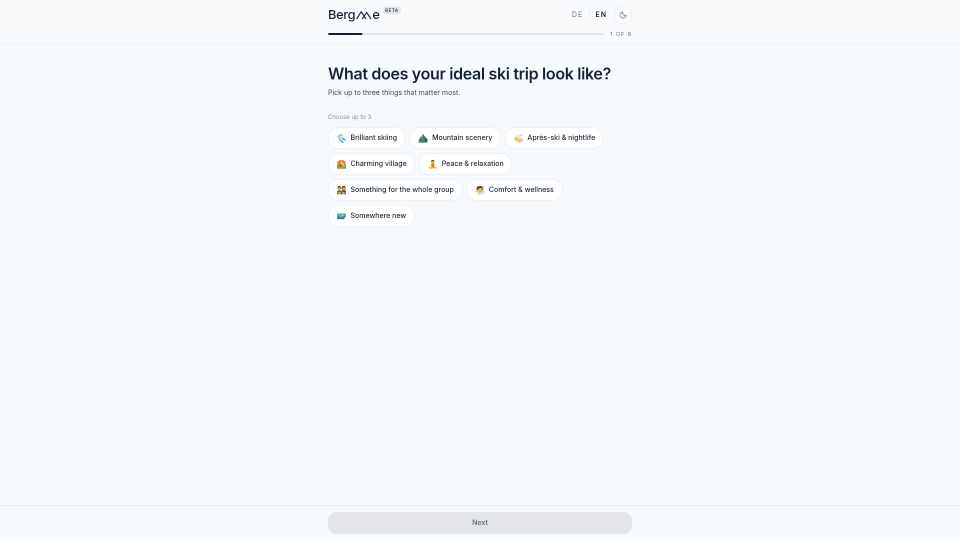
The questionnaire is a practical first step before choosing a lesson format, because the resort determines which lesson packages are on offer at all.
A simple plan for a first ski trip
- Set the group’s level and budget. Note who has skied before, who has not, and the total per person including lodging.
- Choose a resort with a dedicated learning area and easy runs. Use the checklist above rather than total terrain size.
- Pick a package with lesson, rental and lift access. Multi-day packages bring the per-day cost down and match the three to five lesson guideline.
- Book the first lesson for the morning. Early slots mean fresher snow and fewer people.
- Arrange insurance and gear. Confirm that the policy covers skiing and rental damage; bring gloves, goggles and layers.
- Leave room to rest. Practice time after lessons helps, and so does a pause when legs are tired.
FAQ
Is it too late to learn to ski at 40, 50 or 60?
No. Resort instructors report adults starting in their 20s through their 40s and later, and older skiers describe consistency and flat, low-pressure terrain as the keys. Starting on gentle ground, taking several lessons and avoiding speed makes the progression comfortable at any age. A doctor can confirm fitness for the sport.
How long does it take an adult to ski a green run?
Published guidance puts it at one to three days of lessons for most adults, with a recommended plan of three to five lessons before anything beyond a gentle beginner slope. Progress depends on fitness, confidence and how often the skier practices between lessons.
Are group or private lessons better for an adult beginner?
Group lessons are generally the best deal and suit most adults. Private lessons cost more but give individual attention and control over the pace, which helps anxious beginners and mixed-ability pairs. Many resorts sell both, and some package a group lesson with rentals and a lift ticket.
Should a beginner buy gear or rent it?
Renting is the usual advice for a first visit, because rental equipment is fitted at the shop and avoids buying before knowing whether skiing suits you. Many beginner packages include rentals in the price. Gloves, goggles and warm layers are worth having ready.
Sources
- Ski Lessons for Adults: What to Book and What to Expect
- Taking up skiing as an adult, Les Gets
- No Age Limit: Skiing at 60 and Beyond, Tree Line Review
- What can I expect on my first ski lesson?, New Generation
- How to Learn to Ski as an Adult, Home Mountain Ski Club
- Planning Your First Time Skiing or Snowboarding, REI
- First Time Lesson Package, Whitefish Mountain Resort
- Learn 4 Life First-Timer Program, Red Lodge Mountain
- Learn To Turn Pass, Indy Pass
- Guide To Your First Ski Lesson, SkiTutor
- How to Choose Ski Resort for Your Trip, Skier and Snowboarder
- Your Responsibility Code, NSAA Ski Safety
- Preparing for winter sports abroad, GOV.UK
- Cheap Weekend Getaways, Travel Talk Today