29 November 2026
Chamonix vs Zermatt: Which Alpine Resort Fits Your Trip
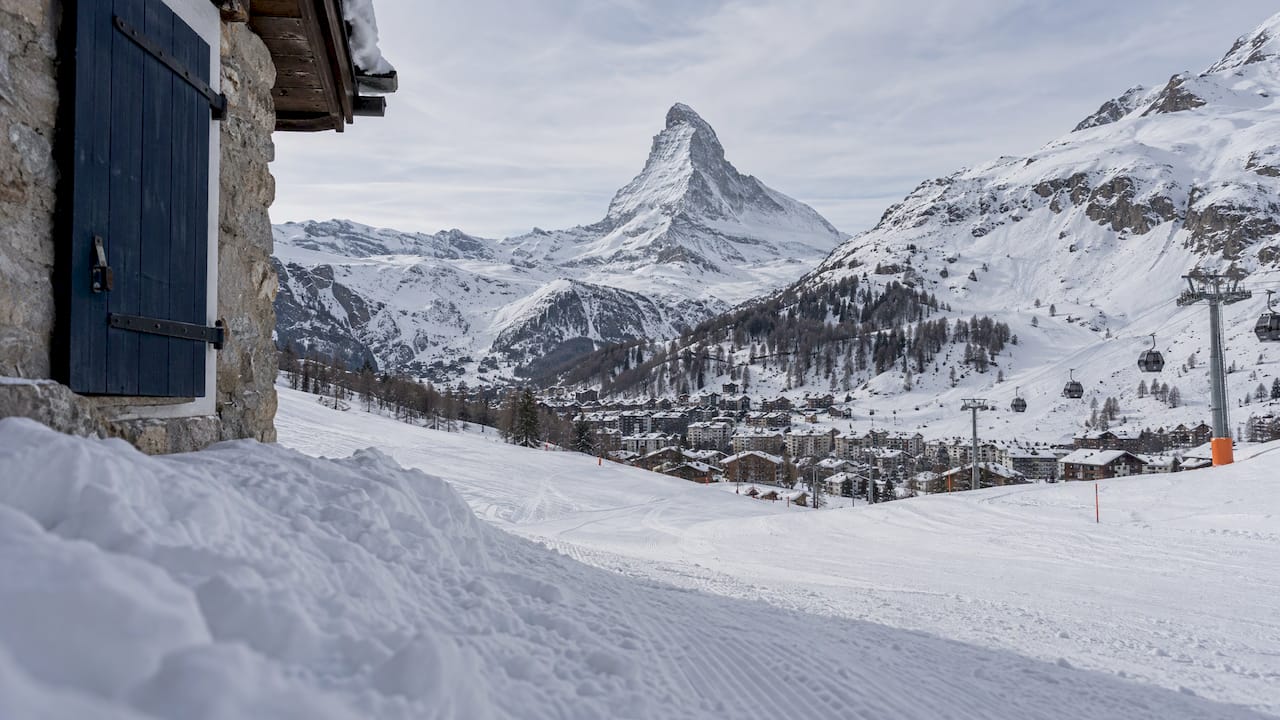
Zermatt suits a week of linked, varied piste skiing in a car-free Swiss village at higher altitude. Chamonix suits skiers who want steep terrain, guided off-piste days and a lower daily cost in a French mountain town. The right choice depends on who is travelling, how many days they have and how much each day should cost. BergMe’s questionnaire is built to settle exactly that trade-off by matching group, skill level and budget to specific resorts and packages.
TL;DR
- Terrain: Zermatt has about 360 km of slopes including the Italian side; Chamonix has about 115 to 155 km, depending on the source, split into four separate areas.
- Cost: Chamonix is cheaper on lodging, food and lift passes. Zermatt’s six-day pass is CHF 384 for 2026/27; Chamonix’s Mont-Blanc Unlimited six-day table starts at €209.40.
- Getting there: Chamonix is about 1h15 to 1h30 by road from Geneva airport; Zermatt takes roughly 2h45 to 3h15 to Täsch plus a shuttle train.
- Best fit: Zermatt for families, intermediates and a relaxed week. Chamonix for strong skiers, guide days and short breaks.
- Verbier and Courchevel: Verbier is steeper and more technical; Courchevel is the strongest of the four for intermediates on groomed runs.
Table of Contents
- The two resorts at a glance
- Terrain and snow
- Lift pass and daily costs
- Getting there
- Which resort suits which traveler
- Chamonix or Courchevel, Verbier or Zermatt
- How to decide in four questions
- Promo
- Perspective
- FAQ
- Sources
The two resorts at a glance
The two towns differ in character before any lift opens. Zermatt sits at 1,620 m, is closed to ordinary traffic and is served by electric taxis and trains. Chamonix sits at 1,035 m, is a working town of about 9,000 residents, and its ski areas lie along the valley. Both figures are listed on a side-by-side resort comparison, which also gives the summit heights: 3,842 m for Chamonix (the Aiguille du Midi) and 3,883 m for Zermatt.
The history differs too. Chamonix is tied to the 1786 first ascent of Mont Blanc and to alpinism, while Zermatt’s identity centers on the Matterhorn, first climbed in 1865, according to a city comparison.
| Chamonix | Zermatt | |
|---|---|---|
| Country | France | Switzerland |
| Village altitude | 1,035 m | 1,620 m |
| Highest lift point | 3,842 m | 3,883 m |
| Slopes | About 115 km (up to about 155 km by other counts) | About 360 km including Italy |
| Ski areas | Four separate domains joined by bus | Linked sectors |
| Currency | Euro | Swiss franc |
Terrain and snow
Zermatt: big, linked and mostly intermediate
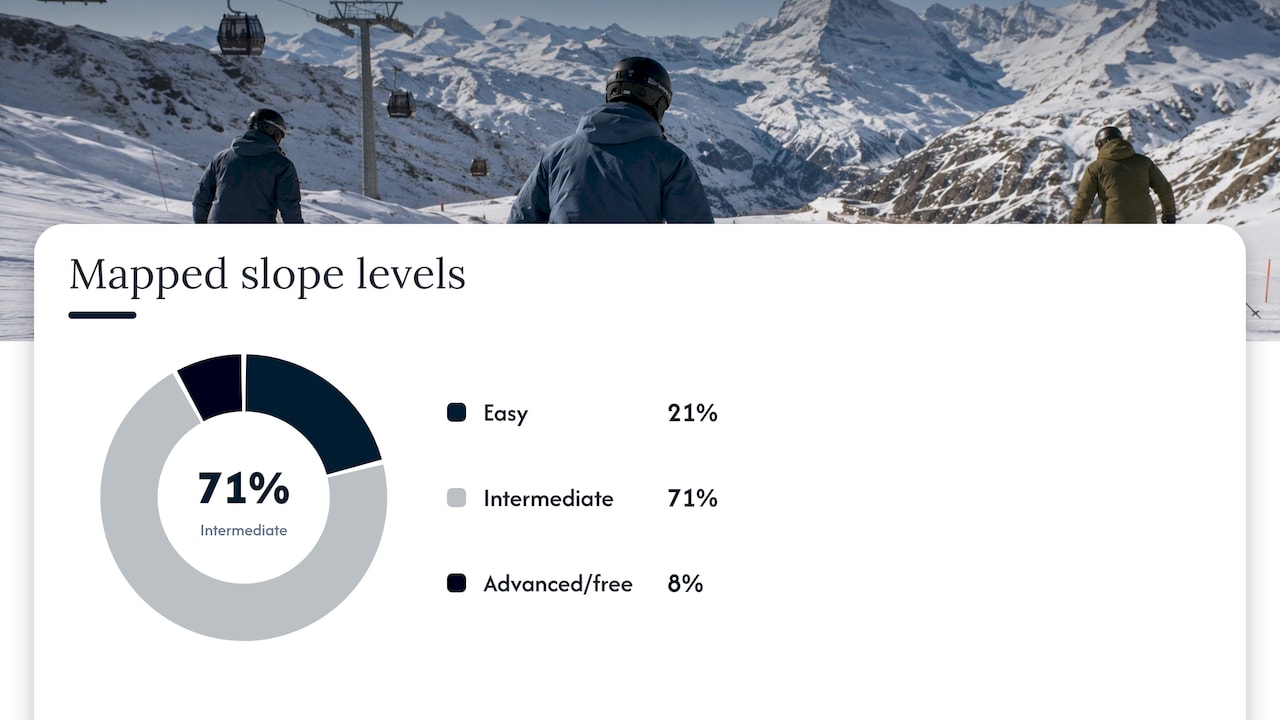
Zermatt’s ski area covers Rothorn, Gornergrat and Matterhorn, with a possible crossing to Cervinia and Valtournenche in Italy, according to Valais tourism. The mapped slopes are roughly 21% easy, 71% intermediate and 8% advanced or freeride, per the resort comparison. A 2026/27 guide lists the 22 km run from the Klein Matterhorn to Valtournenche as the longest marked red run in the world, and notes that wind is the main variable: on a windy day, start lower at Sunnegga or Gornergrat.
The 2026/27 season on the glacier runs from 1 November 2026 to 3 May 2027, with the main areas opening from 28 November, according to a Swiss Alps season guide. The higher base and summit generally mean more dependable snow.
Chamonix: steep, separate and guide-led
Chamonix is not one linked ski area. Les Houches, Brévent-Flégère, Le Tour-Vallorcine and Argentière-Grands Montets are joined by bus, as the 2026/27 French Alps guide explains. The same guide positions the valley for strong skiers, off-piste with a guide and mountaineering scenery. It also notes that the Grands Montets summit has been closed by lift since the 2018 fire.
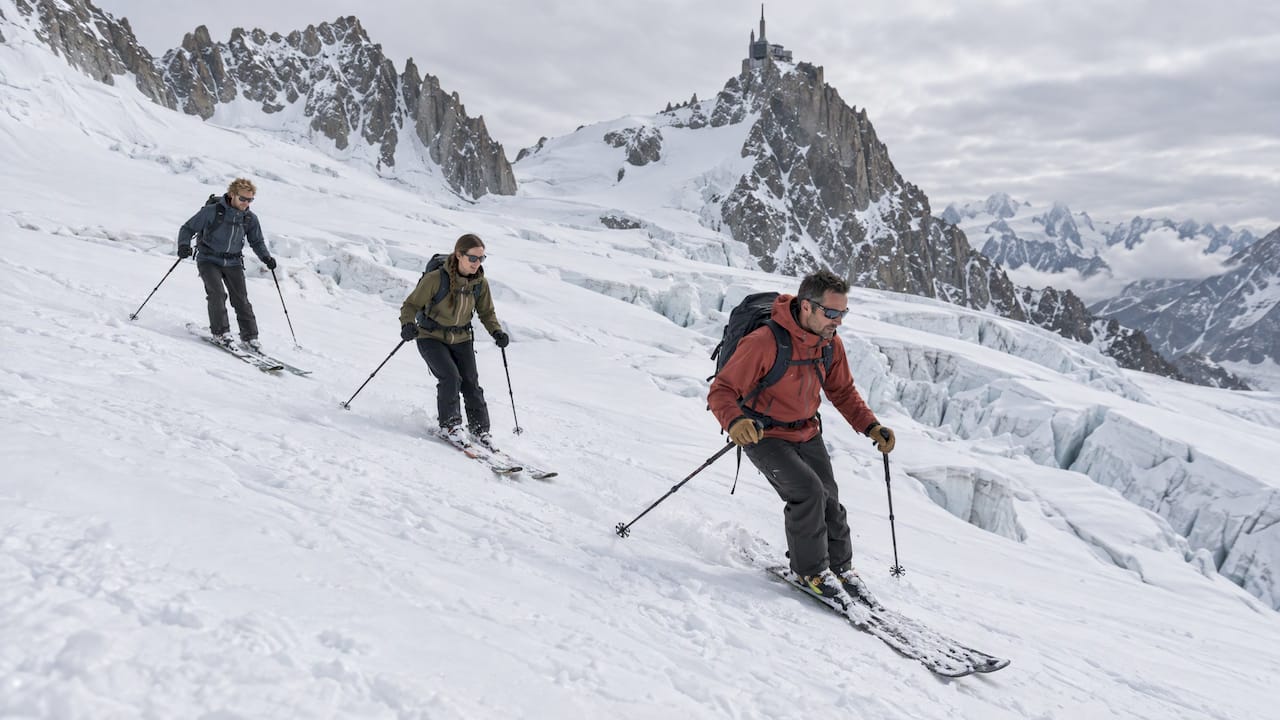
The signature day is the Vallée Blanche, a glacier descent of more than 20 km from the Aiguille du Midi that takes two to five hours and requires a mountain guide, with group outings from €160 listed in that same guide. A week in Chamonix works best when each day has a different purpose: another area, a guided day, the Vallée Blanche.
Verbier and Courchevel in brief
Verbier’s 4 Vallées offers about 410 km of runs and freeride routes up to Mont Fort at 3,330 m, and its terrain is steeper and more technical than Zermatt’s, per the Swiss Alps guide. Courchevel sits in Les 3 Vallées, with 600 km of pistes. The French Alps guide describes it as suited to mixed groups, from gentle blues to the Saulire couloirs. For intermediates, InTheSnow points to wide groomed pistes and good ski schools, and to the lower villages of Moriond and Courchevel Village as better value than Courchevel 1850.
Lift pass and daily costs
Both resorts price lift passes dynamically, so the figure depends on the date. The 2026/27 published prices, in each resort’s own currency:
| Pass | Chamonix (Mont-Blanc Unlimited) | Zermatt |
|---|---|---|
| One adult day | €75 to €104 | From CHF 89 (CHF 104 International) |
| Six adult days | €209.40 to €290.40 early and late season | CHF 384 (CHF 432 International) |
The Chamonix figures come from the French Alps guide, which also gives a cheaper valley-only Chamonix Le Pass at €76.50 at the counter, and notes the 2025/26 peak six-day price was €480. The Zermatt figures come from the Swiss Alps guide. The International tier adds the Italian sector at Cervinia. Children up to 8.99 years ski free in Zermatt, and children under 5 ski free in Chamonix.
For comparison, the same Swiss guide lists Verbier at CHF 94 per day and CHF 409 for six days, and the French guide lists Courchevel at €421 for six days.
On total spending, a 2026 comparison estimates all-in daily budgets of €130 to €230 per person in Chamonix and CHF 200 to CHF 400 in Zermatt, and puts Zermatt roughly 50 to 70% higher for similar quality. It cites a mountain lunch at €15 to €25 against CHF 25 to CHF 45. Treat these as planning ranges: exchange rates, the season week and the type of lodging move them.
For a US traveler, the practical effect is that Chamonix bills in euros and Zermatt in francs. Swiss prices are higher across the board, while the lift pass gap is smaller than the lodging and dining gap.
Getting there
Airport access is the clearest practical difference. Chamonix is 91 km from Geneva, a drive of 1h15 to 1h30. Zermatt is 232 km away: 2h45 to 3h15 by car to Täsch, then a 12-minute shuttle train, or 3h50 to 4h by train via Visp, according to transfer-time data.
Geneva Tourism lists shared shuttles from the airport at €35 to €85 per person each way and private transfers at €150 to €550 per vehicle. It adds that the train is genuinely competitive for Chamonix, since it is cheaper for solo travelers and unaffected by Saturday road traffic. Shared shuttles stop being the cheapest option at about four people.
Zermatt’s nearest airport, Sion, has very limited scheduled service, so most visitors fly into Geneva or Zurich, as a 2026 scorecard points out. For a short break of three or four days, Chamonix’s shorter transfer is a real advantage.
Can you go from Chamonix to Zermatt by train?
Yes, but it is a long day. A rail timetable lists the fastest journey at about 6 hours 54 minutes with several changes. Combining both in one trip is possible, but it uses most of a travel day, so it suits stays of ten days or more better than a single week.
Which resort suits which traveler
Families
Zermatt is easier with young children. A 2026 comparison cites Wolli Park at Sunnegga, the gentle Italian-side pistes and the car-free village as reasons it suits a family week of predictable piste skiing. The same comparison finds Chamonix better for older, bolder children, while the bus logistics between its areas make days harder with under-tens. The Chamonix family rate (two adults and two young people) runs €232.60 to €322.40 per day, according to the French Alps guide.
Couples
Zermatt offers the Matterhorn museum, shopping, fine dining and spas; Chamonix has museums, more bars and a livelier evening scene, according to a Swiss-focused comparison. A couple who want a quiet, scenic week with spa time will usually prefer Zermatt. A couple who ski hard and want lively evenings will find more in Chamonix, at a lower price.
Groups of friends
Mixed-ability groups do better in Zermatt, where one lift pass covers linked terrain and nobody has to take a bus to a different valley. Groups with several strong skiers who want a guide day can split costs in Chamonix. A private guide day there costs €350 to €500, per the 2026 comparison, which becomes modest per head with four or five people.
Value-focused skiers
Chamonix has the lower cost per day for lodging, meals and passes, and its beers and bars cost less as well. Zermatt gives more kilometers per pass day and more reliable snow, which narrows the gap for anyone who skis every day.
Chamonix or Courchevel, Verbier or Zermatt
The decision between the other pairs follows the same logic.
- Chamonix or Courchevel: Courchevel’s five-resort system is linked and efficient, and it suits mixed groups and intermediates. Chamonix is for skiers who prioritize steeps and guided off-piste. Courchevel 1850 is among the most expensive places to eat and sleep in the Alps, as the French Alps guide notes, so the lower villages are the value option.
- Verbier or Zermatt: Verbier hosts the Freeride World Tour final and has steeper, more committing terrain; Zermatt’s off-piste is less committing and its pistes are broader. Zermatt’s six-day pass is lower (CHF 384 against CHF 409). On transfers, Verbier is about 1 hour 50 minutes by car from Geneva, according to a three-resort comparison, against the longer run to Zermatt.
In a 2026 scorecard, Zermatt ranks first of ten resorts at 65/100, ahead of Courchevel at 52 and Verbier at 47, helped by its long published season and top station height.
How to decide in four questions
- Who skis? If the group includes beginners, young children or mostly intermediates, Zermatt or Courchevel. If everyone is advanced and wants steeps, Chamonix or Verbier.
- How many days? Three or four days favor Chamonix’s short Geneva transfer. A full week suits Zermatt’s linked mileage.
- What is the daily budget? Chamonix’s planning range is €130 to €230 per person per day; Zermatt’s is CHF 200 to CHF 400.
- When? Zermatt opens earliest, with glacier skiing from 1 November; Chamonix’s valley season is listed from mid-December, and Les 3 Vallées resorts open in early December. Check each resort’s official page for the current calendar.
Promo
BergMe turns those four questions into a short questionnaire covering skiing style, group makeup and preferences, with no registration or email required. It then ranks resorts and packages that fit, filtering out mismatches. For groups comparing Chamonix, Zermatt and other options, BergMe’s hand-picked ski trips put the matching step in one place.
Perspective
The Chamonix and Zermatt question usually hides a different one: what does this particular group need from a week? A resort that suits two advanced friends can be a poor match for a family with a seven-year-old, even when both resorts are excellent.
We built BergMe around that. The questionnaire takes individual style, group dynamics and preferences into account, then filters out mismatches and ranks resorts and packages, so the comparison is made on the traveler’s terms, not on a resort’s reputation. It needs no registration and no email.
For most readers weighing these two names, the useful result is not a winner but a fit: a linked, car-free week in Zermatt, or a guide-led, lower-cost week in Chamonix, or a third resort that answers the same needs better.
Eduard
FAQ
Is Zermatt better than Chamonix for skiing?
For piste mileage, linked terrain and snow reliability, Zermatt leads, with about 360 km of slopes against roughly 115 to 155 km in Chamonix. For steep terrain and guided off-piste, Chamonix is the stronger choice. The better resort depends on skill level and what each day is meant to include.
Is Chamonix cheaper than Zermatt?
Yes, on lodging, food and lift passes. The 2026/27 six-day passes are published at €209.40 to €290.40 for Chamonix in early and late season and CHF 384 for Zermatt. A 2026 comparison puts total daily costs in Zermatt at roughly 50 to 70% above Chamonix.
Which is easier to reach from Geneva?
Chamonix, by a wide margin: about 1h15 to 1h30 by road, with a train option from the airport. Zermatt takes roughly 2h45 to 3h15 by car to Täsch, then a short shuttle train, or about four hours entirely by rail.
Which is better for a family with young children?
Zermatt is generally the easier option. The village is car-free, the terrain includes gentle pistes and a children’s park at Sunnegga, and children up to 8.99 years ski free. Chamonix’s separate ski areas mean more bus travel on ski days.
Sources
- Chamonix vs Zermatt resort comparison
- Chamonix vs Zermatt city comparison
- Zermatt-Matterhorn, Valais tourism
- Skiing and snowboarding in Zermatt guide
- Ski Swiss Alps 2026/27 guide
- Ski French Alps 2026/27 guide
- The best ski resorts in Europe for 2026, InTheSnow
- Chamonix vs Zermatt 2026 cost comparison
- Ski resorts near Geneva airport transfer times
- Geneva airport ski transfers, Geneva Tourism
- Ski resort scorecards 2026
- Chamonix to Zermatt train times
- Zermatt or Chamonix comparison
- Verbier vs Zermatt vs Courchevel