26 November 2026
How Many Days for a Ski Trip? What the Data Says
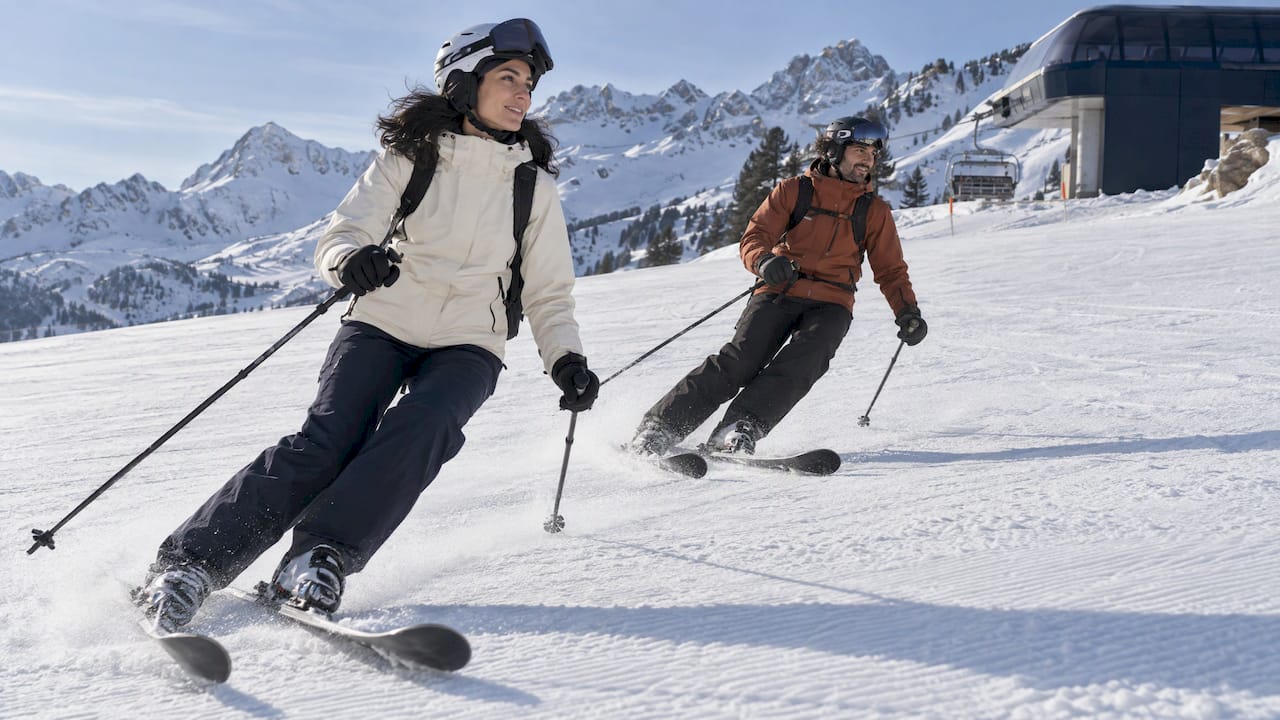
For most skiers, a ski trip of five to seven days works best, which gives roughly four to six days on snow once travel is subtracted. Beginners and families with young children do well with three to five ski days, and advanced skiers chasing a full mountain can use a week or more. The right number depends on skill level, how far the group travels, and how the dates line up with prices. BergMe’s hand-picked ski trips start from a short questionnaire covering group makeup and travel style, so trip length is matched to the group before resorts are ranked.
TL;DR
- The average ski trip in the 2025/26 season was 5.5 days, with a median of 5.0 days. The seven-day Saturday-to-Saturday stay was the most common format.
- Ski days are not trip days. One day is usually lost to arrival and one to departure, so a seven-day trip typically yields five or six days on snow.
- Beginners: three to four ski days. Intermediate: four to six. Advanced: five to seven, with a rest day on longer trips.
- Peak weeks at major resorts are booked six to nine months ahead. Quiet midweek trips can be booked three to four months out.
- Lodging and lift tickets follow different pricing logic, so booking early helps one more than the other.
Table of Contents
- How long a typical ski trip lasts
- Ski days versus trip days
- How many ski days by skill level
- Weekend, midweek or full week
- When to book a ski trip
- What a week costs
- A short checklist for choosing the length
- Our perspective
- Matching trip length to a real itinerary
- Find a trip that fits your group
- FAQ
- Sources
How long a typical ski trip lasts
The most recent large dataset comes from airport transfer bookings in Europe. For the 2025/26 season, the average ski trip lasted 5.5 days, with a median of 5.0 days, unchanged from the season before. Trips of 5 to 7 days made up 58.1% of bookings, and the seven-day Saturday-to-Saturday stay was the single most popular format at 31.5%.
US data points the same way for visitors who travel. A University of Montana survey of 3,400 skiers at seven ski areas in the 2009/10 season found that nonresident skiers averaged 6.66 nights away and 4.64 days of skiing per trip. Three to seven nights was the most common stay. Resident skiers, who live near the mountain, averaged only 1.27 ski days per trip. The gap shows that trip length depends largely on whether the skier needs to travel.
The long-term direction is shorter. Reporting from the Netherlands notes that the average ski holiday was about eight nights in the 1980s and is now around 5.3 days. An Austria Tourism representative quoted there explains that the decline has levelled off, because one day goes to the outbound journey and one to the return. For drivers, the trip is therefore a week away from home however many days are skied.
A European card-spending analysis for the 2025/26 season, covering nine countries, adds a cost angle: domestic ski holidays ran about two days longer than international ones, while international trips averaged about $100 in daily spend per card against about $45 for domestic trips. Longer trips close to home and shorter trips farther away both reflect the same trade-off between travel effort and time on snow.
Ski days versus trip days
A trip length has to be converted into time on the mountain before it can be judged. A working rule:
| Trip length | Typical ski days | Notes |
|---|---|---|
| Long weekend (3 nights) | 2 to 3 | Suits drivers and nearby resorts |
| 5 nights | 3 to 4 | Short flight or one travel leg |
| 7 nights | 5 to 6 | The standard week |
| 10 to 14 nights | 8 to 11 | Usually includes planned rest days |
The figures are working estimates built on the arrival-and-departure logic above, not measured averages. Long-haul arrivals and high-altitude resorts shift them. Guidance for skiers arriving from sea level at a high-altitude resort suggests that the first day will not be the best, and arriving a day early helps with acclimatization.
How many ski days by skill level
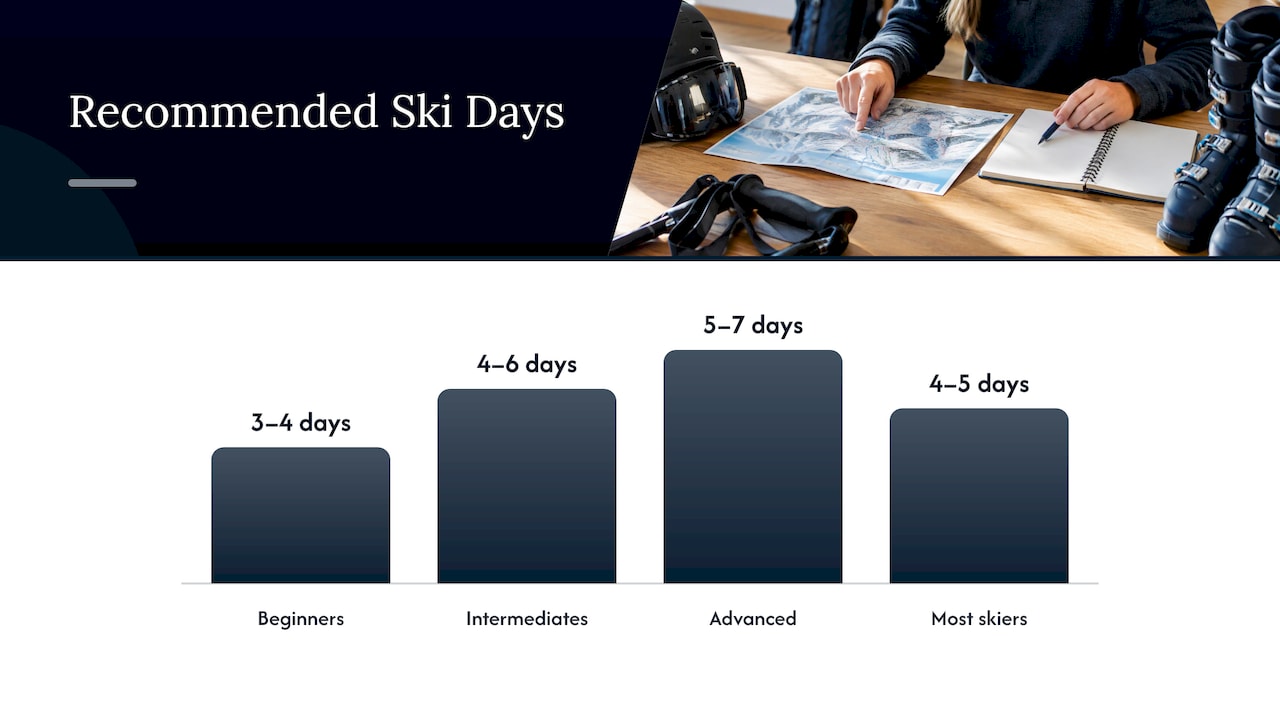
Skill level sets how many days stay productive. One published guide breaks it down as 3 to 4 days for beginners, 4 to 6 for intermediates and 5 to 7 for advanced skiers, with 4 to 5 days the sweet spot for most. The same source adds that on trips longer than six days, most skiers benefit from at least one rest day, and performance tends to fall by day seven without one.
Beginners
The first two days are mostly spent learning. A European guide recommends a full week with lessons for a first-ever ski trip for that reason. Consecutive days matter more than the total: muscle memory builds when lessons run back to back, so a block of four days progresses further than four days spread across separate weekends. Three days is enough to justify the journey but may not leave time to move on from beginner slopes.
Intermediate and advanced skiers
Intermediates gain from four to six days, enough to link runs across a whole ski area and ski in changing conditions. Advanced skiers and those visiting a large linked area can use a week or more, but a rest day or a shorter ski day around day four or five keeps legs fresh for the final days. A common week structure is travel, three ski days, a rest day, two ski days, then travel home.
Families with children
Children change the arithmetic. One family guide recommends half-day skiing until about age eight, with an afternoon pool or rest, full-day ski school from around six or seven, and one non-skiing day built into the week. For very young children a five-night trip with three or four ski days is often easier on the whole family than a full week of lessons and lift queues.

Couples and small groups
Couples and friends have the most flexibility. Five or six days on snow is the figure most often given as the sweet spot, and three days is enough to justify flights but not enough to progress. Groups with mixed abilities do better with a trip that includes a rest day, because the strongest skiers can tackle a bigger mountain while others take a lesson or a spa day.
Weekend, midweek or full week
The calendar shapes both price and crowding.
- Saturday to Saturday. This is the standard in much of Europe, since lodging and lift packages are built around it. A European guide notes that a week with six days on snow is the usual standard and best value because passes, rentals and lodging are priced around it.
- Sunday to Friday. A midweek block frequently gives the same skiing at a lower price with shorter lift lines than a Saturday-to-Saturday week.
- Long weekend. Works well for residents and drivers. For visitors who fly, the cost of travel is spread over very few ski days.
Timing within the season matters too. Mountain Trade Network research cited by The Telegraph found that January and March were the most popular months for British skiers, with January valued for quieter slopes and good-value packages and February for peak snow quality. National Geographic’s family guide identifies February school holidays and New Year’s week as the busiest periods, when lift queues are commonplace and package prices can be double. In the US, the same pressure applies to the Christmas fortnight and Presidents’ Day weekend.
When to book a ski trip
Lead time depends on how popular the dates are and how many beds the group needs.
- Peak weeks at a major resort: one planning guide advises starting six to nine months ahead, because lodging with the right number of beds and ski-school places is the binding constraint in school-holiday weeks.
- Quiet midweek trips in January or late March: three to four months ahead is usually enough, and outside the Christmas fortnight, Presidents’ Day and February school holidays, lodging is often still available about six weeks out at a discount.
- Ski-in/ski-out lodging and holiday peaks: another European guide suggests six months out, and notes that early-bird discounts on lodging and passes can reach 30% when booked six to eight months ahead.
Booking patterns in mountain rental markets bear this out. AirDNA’s winter 2025/26 data put the median booking lead time at 129 days in Val d’Anniviers, 100 days in Morzine and 94 days in Val-d’Isère, against 5 days in Balkan cities. Snow-sure Alpine villages are booked far ahead, while low-demand destinations fill late.
Why lodging and lift tickets behave differently
Early booking does not lower every cost. An analysis of five years of lodging data from ten US mountain resorts found that skiers who booked five months ahead paid about 10% more than the average nightly rate, while last-minute bookers paid well below it. The explanation given is that lift tickets have effectively unlimited inventory and reward early purchase, whereas mountain lodging is limited, and early bookers pay to lock in the exact room and dates they need. The data covers the period through 2013, so it describes a pricing structure rather than today’s rates.
Lift pricing has also become dynamic. Planet Ski reports that European resorts using dynamic lift-pass pricing rose from 5 in 2017/18 to 60 in 2022/23. Verbier’s 6-day 4 Vallées pass costs CHF 409 at the cash desk but CHF 333.90 for the January 12 week, and carries a 10% discount for buying at least 10 days before arrival. The practical conclusion is to fix the dates first, then compare lift pass, lodging and flights as separate items.
Booking lodging around peak dates
On peak dates the room is the constraint, and rooms with a particular feature sell out first. For couples building a trip around a private hot tub after skiing, a directory of winter hot tub getaways shows which hotels have verified private tubs, which narrows the search before dates are fixed. Private ski lessons also book out early in holiday weeks, and flights tend to price best six to eight weeks ahead at minimum.
What a week costs
Length and price move together, though resort tier matters more than a day or two either way. A 2026 guide to European skiing estimates realistic weekly totals per person at €750 to €1,300 for budget and Eastern European resorts, €1,300 to €2,200 for mid-range Austria and Italy, and €2,200 to €3,500 or more for premium France and Switzerland. The same guide puts the season at roughly late November to late April, with the most reliable snow from mid-January into February, and suggests a base above 1,500 m and top lift above 2,500 m for snow-surety. These are published estimates and vary with exchange rates, dates and group size.
A shorter trip to a higher-priced resort can cost the same as a full week at a mid-range one. Per ski day, the longer trip at the cheaper resort usually delivers more skiing, while the shorter trip suits a group that prioritizes a specific mountain.
A short checklist for choosing the length
- Count travel time. Subtract one day each way for a drive or a connecting flight, as the Austria Tourism comment above indicates.
- Set the ski-day target by level. Three to four days for beginners, four to six for intermediates, five to seven for advanced skiers.
- Add a buffer. Keep one movable day that can become a rest day, a powder day or a storm day. One itinerary guide suggests planning about 70% of the time and leaving the rest open for weather and conditions.
- Pick the weekday pattern. Midweek blocks often lower price and queues.
- Choose the booking window. Six to nine months for peak weeks, three to four months for quiet ones.
Our perspective
Trip length is the decision that most often goes wrong, because it is made before anything else. A group picks a week because a week is standard, then finds that the resort suits two days of skiing, or that the youngest child is finished after three half-days.
We build the questionnaire around that problem. It asks about skiing level, who is travelling, and what the group wants from the trip, then filters out mismatches and ranks resorts and packages. Length follows from those answers rather than preceding them. A family with a six-year-old and a couple planning a New Year break need different numbers of days, and the same mountain does not suit both.
There is no registration and no email required. The aim is a short list in minutes, with options that already fit the dates, the group and the number of ski days worth paying for.
Eduard
Matching trip length to a real itinerary
A worked example shows how the pieces combine. A family of four, with two children aged seven and ten, flies in for a February week. Travel takes a day each way, leaving five days on snow. Following the guidance above, the younger child spends the morning in ski school and rests in the afternoon, one day is kept free for non-skiing, and lodging is booked months ahead because February school holidays are the busiest period. Four ski days plus one buffer day fits the group better than six full days.
A couple with intermediate skills and flexible schedules might choose Sunday to Friday in mid-January: five nights, four ski days, lodging at lower midweek pricing, and lift tickets bought ahead where dynamic pricing applies. The two trips use similar numbers of calendar days but differ in what they are built for.
For a holiday-period trip, a package that bundles lodging and a pass removes some of the date-matching work. One example on our site is a New Year ski holiday in Interlaken at Hotel Bären, offered with a ski pass. New Year’s week is among the busiest periods of the season, so dates and lodging are worth settling early.
Find a trip that fits your group
BergMe’s questionnaire turns skill level, group makeup and preferences into a ranked list of resorts and packages, with no registration or email. Families, couples and friends who want a quick comparison can start with the hand-picked ski trips and see which resorts and trip lengths match their group.

FAQ
How many days is a typical ski trip?
The 2025/26 season average was 5.5 days, with a median of 5.0 days, according to European transfer booking data. About 58% of trips lasted 5 to 7 days, and the seven-day Saturday-to-Saturday stay was the most common single format at 31.5%.
How long should a ski trip be for a beginner?
Three to four ski days is the range most guides give, and a full week with lessons suits a first-ever trip because the first two days go to learning the basics. Consecutive days build skill faster than separate ones. Children under about eight often do better with half-day skiing and an afternoon rest.
When should I book a ski trip?
Peak weeks such as Christmas, New Year, February school holidays and Presidents’ Day are typically booked six to nine months ahead at major resorts. Quiet midweek trips in January or late March can often be booked three to four months out. Lift passes tend to be cheaper when bought early, while lodging does not always follow the same rule.
Is a long weekend enough for a ski trip?
For skiers who live within driving distance, two to three ski days are a good fit. For anyone flying in, three days is generally the point at which the trip justifies the journey but leaves little time to progress, so four or five days gives better value.
Sources
- The Ski Week Isn’t Dying. It’s Just Getting Busier
- Economic Impact and Skier Characteristics: Montana
- Korter en vaker op skivakantie is de trend (AD.nl)
- Inside Europe’s Ski-Season Travel Economy (Visa)
- How Many Days Of Skiing Is Good? Ideal Trip Length Advice
- How to Plan a Ski Trip Itinerary
- Skiing in Europe 2026: Best Resorts, Costs & Season
- Family Ski Vacation: 2026/27 Planning Guide
- How to Plan a Ski Trip: 2026/27 Step-by-Step
- How to book a ski holiday: Everything you need to know (The Telegraph)
- How to plan a family ski trip (National Geographic)
- Cheapest and Most Expensive Winter Destinations in Europe (AirDNA)
- Are advance bookers of ski vacations paying more? (InnTopia)
- Dynamic Pricing for Ski Lift Passes on the Rise in Europe (Planet Ski)