28 November 2026
Longest Ski Runs in the World, Europe and North America
The longest ski run in the world depends on how a run is defined. Guinness World Records lists the Parsenn course at Davos, Switzerland, as the longest all-downhill run at 12.23 km (7.6 miles). Alpe d’Huez in France markets the Sarenne at 16 km (9.9 miles), and Zermatt advertises routes of 22 km and more that include a lift ride. In North America, Revelstoke’s Last Spike and Whistler’s Peak to Creek are the usual answers. This guide sets out the figures, shows why they differ, and explains how to use run length and vertical drop when choosing a resort for a family, a couple or a group.
TL;DR
- The longest continuous, all-downhill run on record is the Parsenn course at Davos (12.23 km, 7.6 miles). Alpe d’Huez’s Sarenne (16 km, 9.9 miles) is the longest black run in Europe and is skied without a lift.
- In North America, Revelstoke has the largest vertical drop (5,620 ft) and The Last Spike as its longest run. Whistler’s Peak to Creek and Sugarloaf’s Tote Road are the other well-known long descents.
- Published lengths differ because sources count linked pistes, mid-run lifts and sometimes off-piste sections differently.
- Length matters less than the grade of the run and the vertical it drops. Long green and blue runs exist, so the longest run in a resort is not only for experts.
Table of Contents
- What counts as a ski run
- The longest runs in the world
- Longest runs in Europe by difficulty
- The longest ski runs in North America
- Why published lengths do not match
- Vertical drop: the figure that predicts a big day
- How to choose a long run for your group
- Perspective
- Find the right resort for your group
- FAQ
- Sources
What counts as a ski run
A piste, or trail in North American usage, is a marked and groomed route. A ski run in everyday speech can be that, or a chain of pistes skied top to bottom. The difference explains most of the disagreement in rankings.
Jay Cowan, writing for Skiing History, describes the question of the longest run as full of caveats: vertical against length, lift-served against hike-out, maintained against off-piste. He suggests ranking by both vertical and length, then sorting by lift service. That is a practical way to read every table below.
Three questions sort the claims:
- Is it one named piste or several linked together?
- Does it require a lift, bus or hike partway down?
- Does the figure come from the resort’s marketing or from a map measurement?
The longest runs in the world
Davos Parsenn: the record holder
Guinness World Records lists the Weissfluhjoch to Küblis Parsenn course near Davos as the longest all-downhill ski run, at 12.23 km (7.6 miles). Skiing History reports the same run at 12.3 km with 2,034 m (6,692 ft) of vertical, and notes that “all downhill” excludes routes with a hike, a mid-run lift or a bus ride at the end.
Zermatt: longer, but with a lift
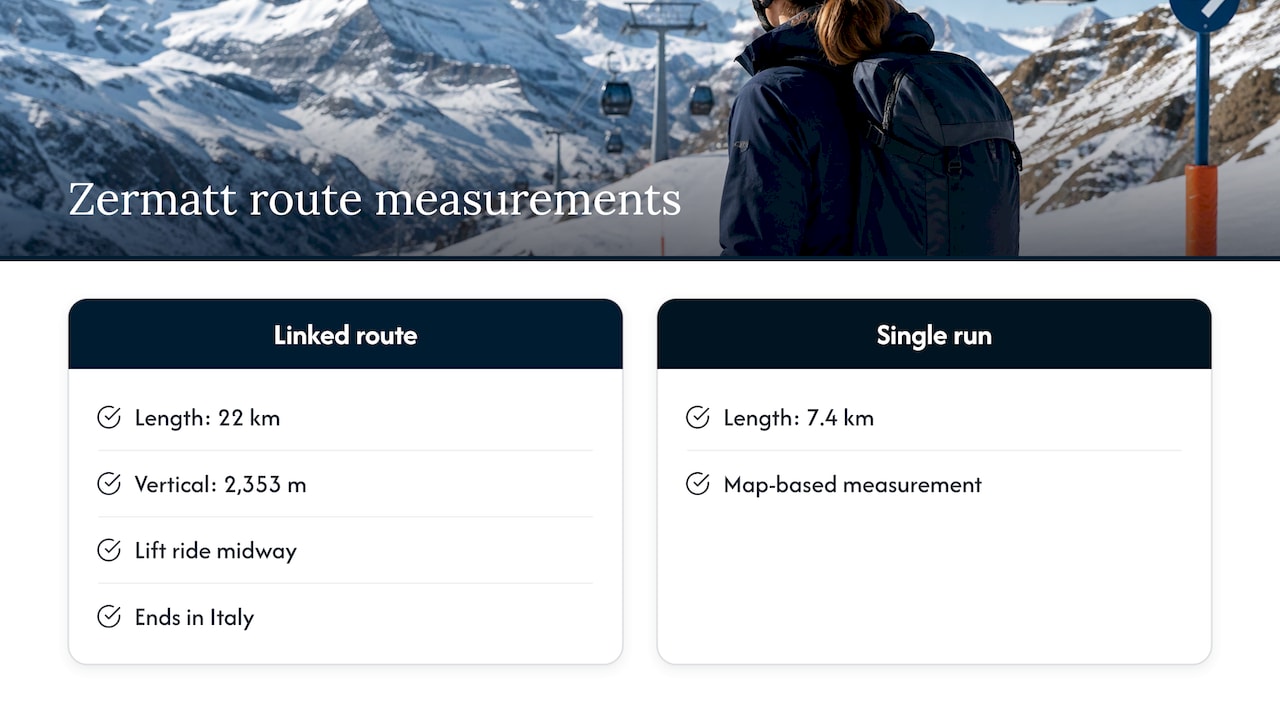
Zermatt advertises longer numbers. Skiing History describes the 22 km (about 13.7 miles) Klein Matterhorn to Valtournenche route as measuring 2,353 m (7,739 ft) of vertical and ending in Italy. It needs a lift ride in the middle, so it does not meet the continuous-descent standard. It remains one of the great days on skis in the Alps, and the border crossing is part of the appeal.
Map measurements tell a different story from marketing totals. One independent map-based measurement of the Zermatt and Breuil-Cervinia area puts its longest single measured run at 7.4 km, a reminder that the long routes there are chains of pistes rather than single trails.
Alpe d’Huez Sarenne: the long black run
The resort’s own page calls the Sarenne the longest black piste in Europe: 16 km from the Pic Blanc summit at 3,330 m. The resort’s official blog describes it as a single descent without another lift, ending near 1,500 m with more than 1,830 m of vertical drop. Other French resort pages give a lower finish and a larger drop, because the end point depends on whether the run is taken down to the valley village. Check the finish point before comparing vertical figures.
Longest runs in Europe by difficulty
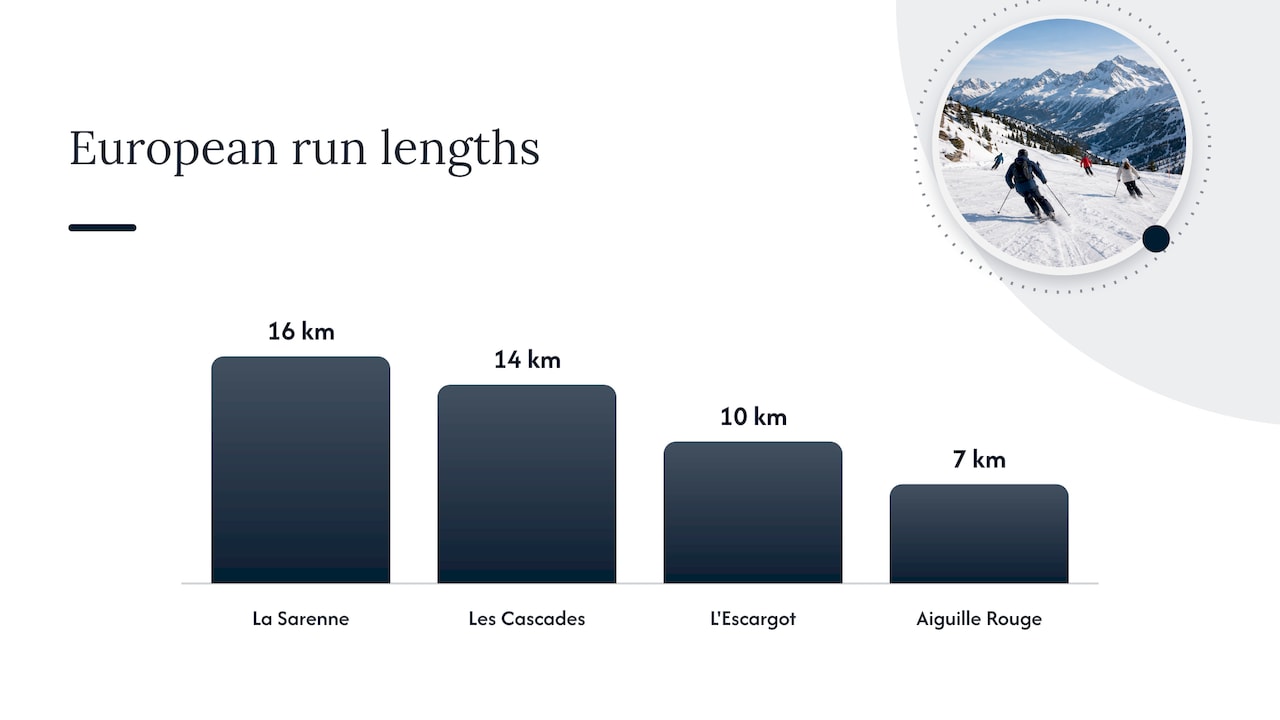
A long run is not automatically a hard one. OnTheSnow’s 2025 list shows long descents at every level, which matters for families and mixed-ability groups.
| Run | Resort | Approx. length | Level | Notes |
|---|---|---|---|---|
| La Sarenne | Alpe d’Huez, France | 16 km (9.9 mi) | Black | Starts at 3,330 m, no mid-run lift |
| Les Cascades | Flaine, France | 14 km (8.7 mi) | Blue | From Grandes Platières to Sixt-Fer-à-Cheval, about 1,800 m vertical |
| L’Escargot | Val Cenis, France | 10 km | Green | Longest green run in Europe, from 2,050 m to roughly 1,400 m |
| Aiguille Rouge | Les Arcs, France | 7 km | Black easing to red and blue | From 3,226 m to Villaroger, over 2,000 m vertical |
Lengths and vertical drops are approximate and vary by source. OnTheSnow itself notes that it uses “ski run” loosely and that some entries are linked descents rather than single pistes.
The Les Arcs entry is a useful contrast. At about 7 km it is far shorter than the Sarenne, yet its vertical is among the largest on-piste drops in the Alps. Vertical drop, not length, determines how much sustained skiing a descent contains and how tired the legs are at the bottom.
Sticking to Swiss terrain
Switzerland combines long descents with villages that work as bases for beginners and experts alike. Skiers who want a Swiss New Year week can look at the New Year ski holiday in Interlaken with Hotel Bären and ski pass, which pairs a hotel stay with lift access.
The longest ski runs in North America
North American trails are shorter than the Alpine headline runs, because resorts are built around a single mountain rather than a linked valley system. They are still long by any standard, and several are suited to beginners.
| Run | Resort | Length | Level | Vertical context |
|---|---|---|---|---|
| The Last Spike | Revelstoke, BC | 9.5 mi (15.2 km) per the resort | Green to intermediate | Resort vertical 5,620 ft |
| Peak to Creek | Whistler Blackcomb, BC | 6.8 mi (11 km) | Linked descent | Whistler vertical 1,530 m |
| Tote Road | Sugarloaf, Maine | 3.5 mi | Beginner to intermediate | Resort vertical 2,820 ft |
| Schoolmarm | Keystone, Colorado | 3.5 mi (5.6 km) | Green | 718 m vertical |
Sources: Revelstoke’s official materials, Whistler Blackcomb, OnTheSnow on New England and Skipedia on Keystone.
Revelstoke: the vertical leader
Revelstoke’s materials state a vertical drop of 5,620 ft (1,713 m), described as the most in North America, and list The Last Spike at 9.5 miles. Skiing History reports the same run at 8.3 miles (13.4 km), descending the resort’s full vertical. The gap between 9.5 and 8.3 miles is a typical example of how lengths change with the route measured, and with whether a run is measured along a groomed line or the fall line.
Whistler Blackcomb: linked runs
Whistler’s Peak to Creek is a long linked descent rather than one piste, as OnTheSnow points out. It is a full-day descent for confident intermediates and is skied by many visitors as a bucket-list run.
Keystone and Sugarloaf: long and gentle
Schoolmarm at Keystone is a green run of about 3.5 miles, and Tote Road at Sugarloaf runs 3.5 miles from summit to base on a beginner-to-intermediate line served by the Timberline High-Speed Quad. For a family with young skiers, these runs deliver the feeling of a summit-to-base descent without black-diamond terrain.
Why published lengths do not match
Expect two figures for most famous runs. The reasons are consistent:
- Linked pistes. Several named pistes are counted as one route, as with Peak to Creek and many Austrian routes that combine pistes.
- Mid-run lifts. The Zermatt to Valtournenche route has a lift partway, while the Sarenne is promoted as lift-free.
- Different end points. A run finishing at a village or a valley station can add several hundred meters of vertical.
- Different measurement methods. Resorts publish rounded marketing figures, while map-based tools measure the line on a digital terrain model.
A simple rule: compare the vertical drop and the grade first, and treat length as the secondary figure.
Vertical drop: the figure that predicts a big day
The resorts with the biggest vertical drops are the ones where a single descent takes the longest in time. Revelstoke leads North America with 5,620 ft. In the Alps, the Sarenne, the Aiguille Rouge at Les Arcs and the Zermatt to Valtournenche route all lose well over 1,800 m in one trip.
For trip planning, vertical matters in three practical ways:
- Snow quality changes along a run. A run that starts on a glacier at 3,300 m and ends in a valley village can have powder at the top and slush at the bottom in spring.
- Fatigue. A 2,000 m descent without a break is demanding on thighs and knees, even on a red or blue grade.
- Timing. Long descents are best skied early, before the lower sections soften and fill with traffic.
How to choose a long run for your group
The longest run is a good anchor for a trip, but the right resort depends on who is going.
Families
Look for long green and blue runs such as L’Escargot at Val Cenis, Schoolmarm at Keystone or Tote Road at Sugarloaf. Check that the run is reachable by a lift children can ride and that there is a point to stop partway for food.
Couples
Couples who ski at similar levels usually do best at a resort with one signature descent and a village for the evenings. Zermatt is car-free, and its descent from the Klein Matterhorn at 3,883 m ends in a village at 1,620 m.
Frequent skiers and value seekers
A resort with a large vertical and many lifts gives more skiing per day. The best value is not always the biggest resort: a long run on a mid-priced lift ticket beats a famous run on an expensive one.
Friends and mixed-ability groups
Choose terrain where the long blue or red run and the long black run start from the same lift. The group can split at the top and meet at the bottom. The Sarenne and Les Cascades are examples of long descents that groups can ski together.
Planning beyond the slopes
Some travelers extend a winter trip with a warm-weather itinerary elsewhere. For the American Southwest, Grand Staircase-Escalante tours are one way to build that into a longer vacation.
Perspective
Run lists are a good starting point, but they answer a question most travelers did not ask. Nobody books a week because one piste is 16 km. They book because the terrain matches the people in the group: the strongest skier, the least confident one and the budget.
This is why our questionnaire asks about skiing style, group makeup and preferences before it recommends anything. It filters out mismatches and ranks resorts and packages, so a family does not end up at a resort whose famous run is a black, and an expert does not end up somewhere with only gentle slopes.
We built it so that no registration or email is needed. You answer the questions and see the options. For anyone comparing long runs across resorts, that is the fastest way to turn a record list into a short list.
Eduard
Find the right resort for your group
Bergme offers hand-picked ski trips matched to your answers in a short questionnaire, with no registration or email required. It takes into account your skiing style, who is traveling and what you want from the trip, then ranks resorts and packages that fit. Start at Bergme’s hand-picked ski trips.

FAQ
What is the longest ski run in the world?
Guinness World Records recognizes the Parsenn course at Davos, Switzerland, as the longest all-downhill run, at 12.23 km (7.6 miles). Longer routes exist, such as Zermatt’s 22 km run to Valtournenche, but they include a lift ride partway.
What is the longest piste in Europe?
The Sarenne at Alpe d’Huez, France, is promoted as Europe’s longest black run at 16 km (9.9 miles). It starts at Pic Blanc at 3,330 m and is skied in one descent without another lift.
Which ski resorts have the most vertical?
Revelstoke in British Columbia states a vertical drop of 5,620 ft, the most in North America. In the Alps, Les Arcs’ Aiguille Rouge descends more than 2,000 m by one resort’s figures, and the Sarenne drops over 1,800 m.
Are the longest ski runs only for experts?
No. Val Cenis has L’Escargot, a green run of about 10 km, and Flaine’s Les Cascades is a blue run of about 14 km. In North America, Keystone’s Schoolmarm and Sugarloaf’s Tote Road are 3.5 miles long and suit beginners and intermediates.
Why do different sites give different lengths for the same run?
Sources differ on whether linked pistes count as one run, whether a lift partway is allowed and where the run ends. Revelstoke’s Last Spike appears as both 9.5 and 8.3 miles for this reason.
Sources
- World’s Longest Ski Runs, Skiing History
- Longest run, downhill (Skiing), Guinness World Records
- The Sarenne, Europe’s longest ski run, Alpe d’Huez
- Piste la plus longue d’Europe, Alpe d’Huez
- 11 of the Longest Ski Runs in the World, OnTheSnow
- The Longest Ski Runs in New England, OnTheSnow
- Keystone Ski Resort, Skipedia
- Most Vertical in North America, Revelstoke
- Whistler Blackcomb, Wikipedia
- Zermatt - Breuil-Cervinia piste and lift map, Ski Info App