1 September 2026
Match Your Skiing Profile to Ski Pass Options With BergMe
If you ski fewer than 10 days a season and stick to one region, a regional or single-resort season pass usually beats a multi-resort option. Frequent local skiers do best with unlimited portfolio passes, destination travelers get more from multi-resort day-limited passes, and occasional or beginner skiers often save money on day tickets. The trade-off is always cost versus flexibility, and a tool like BergMe can confirm the match against your actual travel plans in minutes.
TL;DR:
- Choosing between ski passes depends heavily on your actual ski days and travel patterns rather than the number of resorts included.
- Multi-resort day-limited passes suit destination travelers or occasional skiers, while unlimited passes benefit those skiing frequently at a few home resorts.
- Early-bird pricing and careful review of blackout dates, reservation rules, and additional costs can significantly influence the true value of a pass.
- Most skiers should prioritize estimating their ski days and travel footprint over resort count when selecting the best pass.
- BergMe’s matching tool efficiently aligns your skiing habits with the most suitable pass category, saving money and avoiding unnecessary flexibility.
Table of Contents
- What Are the Main Ski Pass Types?
- How Do You Choose Between Ski Pass Options?
- What Do Ski Passes Cost, and When Should You Buy?
- What Restrictions Should You Check Before Buying a Pass?
- How Does BergMe Match You to the Right Pass Category?
- Editorial Take: Stop Ranking Passes and Start Ranking Yourself
- Sources
What Are the Main Ski Pass Types?
Ski pass options fall into four broad categories, and understanding what each one actually delivers keeps you from overpaying for access you’ll never use.
Multi-resort day-limited passes bundle a set number of days at a large network of resorts. Mountain Collective, for example, typically offers two days at each partner resort, with discounts on additional days once you’ve used your allotment. This structure suits skiers who want variety across a season without committing to unlimited access anywhere.
Unlimited or portfolio passes work differently. Passes like Ikon trade a higher upfront price for broad, often unrestricted access to a core group of resorts, plus limited days at expanded partner mountains. If you ski often at a handful of home resorts, this is usually the better financial bet.
Regional and single-resort season passes cover one mountain or a cluster of nearby resorts owned by the same operator. These tend to be the cheapest per-day option for someone who skis one place repeatedly and doesn’t care about travel variety.
Session and short-term passes cover a fixed window, often a few weeks or a single season phase, and beginner passes typically bundle lessons with limited-day access. These fit newer skiers or anyone testing a resort before committing to a full season.
A few things to keep in mind as you sort through the pass types:
- Day-limited multi-resort passes reward variety over volume.
- Unlimited passes reward loyalty to a small set of home mountains.
- Regional passes reward proximity and repetition.
- Session and beginner passes reward low commitment and low risk.
How Do You Choose Between Ski Pass Options?
Comparing ski pass options is less about which one offers the most resorts and more about matching the pass to how you actually ski. A five-step checklist gets you there faster than any spreadsheet of resort counts.
- Estimate your ski days and calculate the break-even point. Powder7’s pass comparison recommends dividing the pass price by your expected number of ski days, then comparing that per-day cost against a typical single-day lift ticket at your home resort. If the math lands under the ticket price, the pass wins.
- Evaluate your travel footprint. Local skiers who rarely leave their region get more value from unlimited access at one or two mountains. Destination travelers who fly to two or three different states in a season benefit more from day-limited multi-resort passes, since they’re only using a handful of days at each stop anyway.
- Check reservation rules and blackout dates before buying, not after. Some unlimited passes require advance reservations at peak-capacity resorts during holidays.
- Weigh the perks that matter to you. Lodging discounts, family pricing, and partner benefits can shift the value equation more than the headline price.
- Review payment, refund, and transfer conditions. Payment plans reduce the upfront hit, but refund windows are often narrow once the season starts.
Pro Tip: Run the break-even math for two scenarios, your realistic ski days and your optimistic ones. If the pass only pays off in the optimistic scenario, buy day tickets instead.
What Do Ski Passes Cost, and When Should You Buy?
Pricing bands vary widely, but a rough pattern holds across most providers. Entry-level regional and single-resort season passes often land in the lower price tier and cover one mountain. Multi-resort day-limited passes sit in a middle tier, since they’re capped at a couple of days per partner. Unlimited portfolio passes command the highest upfront price, reflecting the breadth of access.
Timing matters more than most buyers realize. Early-bird pricing windows, usually running from spring through early fall, offer the lowest rates. Limited-issue passes carry real sellout risk: Indy Pass has historically capped sales and used waitlists to manage demand and protect partner resort capacity, so waiting until December can mean missing out entirely.
Two quick examples show how the math plays out:
- A family skiing six days total across one home mountain often breaks even on a regional season pass if each member would otherwise buy two or three day tickets.
- A single traveler taking two separate destination weeks (roughly eight days at two different resorts) usually gets better value from a multi-resort day-limited pass than an unlimited one, since they’re never skiing more than four days at any single location.
Factor in hidden costs too: parking fees, lift-ticket top-ups once you exceed included days, and lodging often add more to your season total than the pass itself.
What Restrictions Should You Check Before Buying a Pass?
Every pass carries fine print that changes its real-world value, and the details vary enough between providers that skimming the fine print once isn’t optional.
Blackout dates block pass use entirely on specific high-demand days, usually around holidays. Reservation requirements are different: the pass still works, but you need to book a spot in advance, and some resorts cap daily passholder volume even with a reservation in hand. Day allowances reset differently depending on the pass, and activation windows determine when your season technically starts, which isn’t always the day you receive the pass.
Partner-resort perks like lodging, retail, and lesson discounts (common on passes like Mountain Collective) can add real value, but they usually apply only at specific partner properties, not universally across every resort on the pass.
Before your first day on snow, verify:
- Your pass is activated (many providers require this step online before arrival)
- You’re carrying valid ID that matches the pass registration
- Whether your resort uses a mobile pass, RFID card, or physical ticket, since Ikon and similar providers mix formats across their network
| What to check | Why it matters |
|---|---|
| Blackout dates vs. reservation rules | Blackouts block use outright; reservations just require booking ahead |
| Day allowance reset | Determines if unused days carry over or expire |
| Activation window | Sets when your season actually begins, not just purchase date |
| Format (mobile, card, physical) | Wrong format at the gate means a delay or a service desk visit |
How Does BergMe Match You to the Right Pass Category?
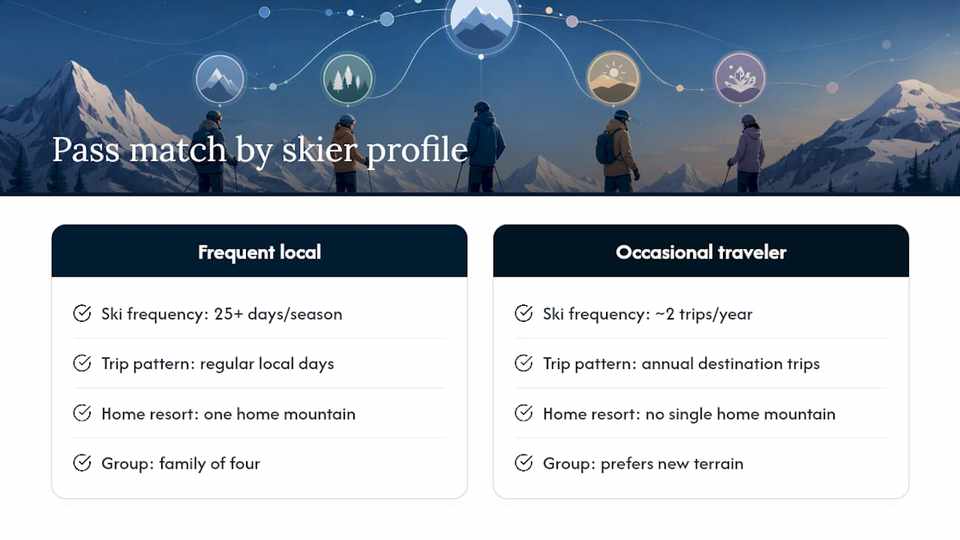
BergMe’s questionnaire asks about ski frequency, trip length, home resort access, and group type, then converts those answers into a short list of pass categories worth pursuing. A skier who reports 25+ days a season, one home mountain, and a family of four points toward an unlimited portfolio pass. A skier who reports two annual destination trips and a preference for new terrain points toward a multi-resort day-limited pass instead. Neither profile benefits from the other’s pass type, which is the core problem with generic “best pass” rankings.
The next step is straightforward: run your own numbers through the matching tool to see estimated price ranges and packages built around your actual travel pattern, including options that bundle lodging with a season pass for a single trip.
Editorial Take: Stop Ranking Passes and Start Ranking Yourself
Most ski pass comparisons rank passes by resort count, as if 40 mountains beats 20 by default. That logic falls apart the moment you check your own calendar. A skier with eight vacation days a year gets zero extra value from a pass covering 300 resorts if they only ever visit two of them.
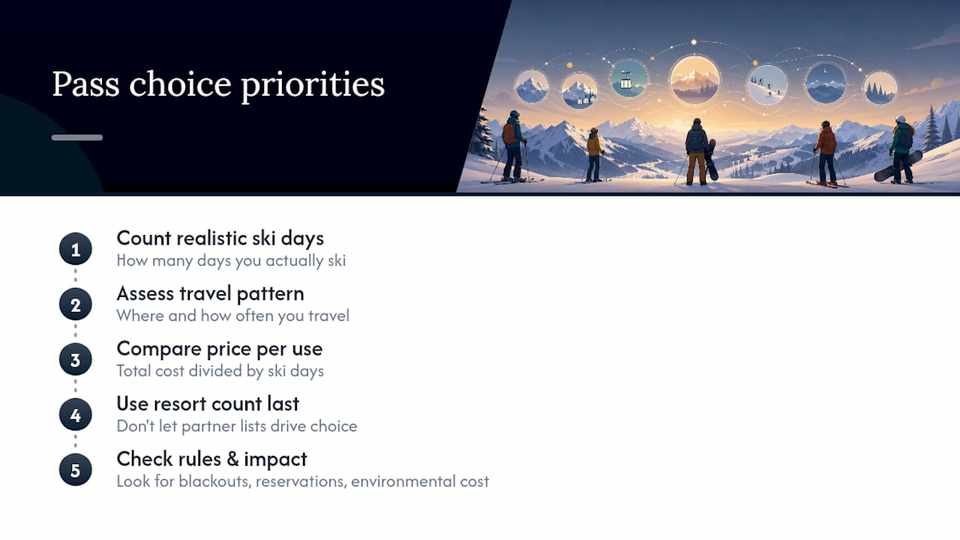
The conventional advice undersells blackout dates and reservation rules, which matter more than resort count for most buyers, and it rarely mentions that travel-heavy passes carry a real environmental cost worth weighing, a point Protect Our Winters has pushed for years.
Here’s what I’d prioritize instead: count your realistic ski days first, then your travel pattern, then price. In that order. Resort count should be the last filter you apply, not the first. If you’re skiing one region eight times a season, a season pass beats an unlimited portfolio pass on price every time, no matter how impressive the partner list looks on the marketing page — and for planning your mountain stays, see this guide to kampi v Julijskih Alpah.
— Eduard