8 October 2026
Ski Resort Crowds: Use Holiday Dates and Live Signals to Dodge Lines

Holiday weeks and powder Saturdays drive the heaviest crowds at almost every ski resort, and the single most reliable fix is skiing midweek outside those holiday windows or getting to the lift extremely early when fresh snow falls on a weekend. Road conditions, parking limits, and pass-holder surges can still override a quiet-looking calendar date, so a good plan checks both the schedule and the live conditions on the morning of travel.
TL;DR:
- A fresh storm or newly opened pass access can overwhelm a quiet weekday, so check resort webcams, snow reports, road conditions, and parking before departure.
- Crowd calendars are modeled forecasts, not live occupancy counts; use them to choose dates, then verify same day conditions before committing to the drive.
- Early December and April can bring lighter crowds and lower lodging costs, but variable snow coverage may limit open terrain, so check resort snow reports.
- Denver and Bay Area corridor resorts face weekend traffic and road controls, while destination resorts spread visitors across the week but still fill during holidays.
- Arriving for first chair and using secondary lifts or alternate base areas can reduce bottlenecks, while advance parking reservations help avoid full lots.
Table of Contents
- When resorts are busiest: calendar windows and month-by-month patterns
- Primary crowd drivers: powder days, pass-holder spikes, and road or parking bottlenecks
- Practical tactics to avoid crowds: date selection and on-the-day moves
- Regional patterns and examples: illustrative resorts and differing dynamics
- Using live signals and tools to refine day-of crowd risk
- Author perspective: applying these rules when matching quieter ski trips
- Impact of crowd levels on skiing experience and lift wait times
- How resort crowd levels affect accommodation and dining availability
- Trends in crowd levels over recent years and the impact of changing travel behaviors
- Seasonal variations beyond holidays: early and late season crowd tendencies
- Why the conventional crowd-avoidance advice misses the point
- Find quieter ski trips faster with BergMe
- FAQ
- Sources
When resorts are busiest: calendar windows and month-by-month patterns
Ski resort crowd levels follow a predictable rhythm built around school breaks and long weekends. Crowd estimates and month outlooks consistently flag Christmas through New Year’s, Martin Luther King Jr. weekend, Presidents’ Day week, and spring break stretches as the strongest recurring peaks across the season.
Within any given week, weekends, especially Saturday, tend to be the busiest days at resorts that draw heavy day-trip traffic, since weekday workers and weekend visitors overlap with locals doing their one ski day of the week. Midweek, particularly Tuesday through Thursday, tends to run noticeably quieter at the same resorts.
Looking at the full season, Early to mid-winter months usually carry the highest sustained crowd levels because they combine reliable snow with school holidays. Shoulder months like early December and April often run quieter, though snow coverage becomes the limiting factor rather than crowd size.
- Holiday weeks (Christmas to New Year’s, MLK, Presidents’ Day, spring break) are the most consistent peak windows across nearly all resorts.
- Saturdays are usually the busiest single day, with midweek days running quieter in day-trip markets.
- January through March carries the heaviest season-long demand, while early December and April tend to be lighter on crowds.
Primary crowd drivers: powder days, pass-holder spikes, and road or parking bottlenecks
Calendar patterns explain most of the picture, but a few non-calendar triggers can flip a normally quiet day into a packed one. A fresh overnight storm can turn a midweek Tuesday into the busiest day of the month, because skiers who track snow reports will rearrange their schedules to chase it.
Multi-resort pass programs add another layer. When a widely held pass releases new access or a blackout period lifts, pass holders can concentrate at specific resorts on short notice. Road and parking limits compress the effect further: chain control along mountain corridors, paid or reserved parking lots, and limited base-area access can all throttle how many cars actually reach the lifts, regardless of how many people wanted to come.
Waiting time at the lift measurably changes the skiing experience and what people are willing to pay for it. Research on alpine ski pass pricing found that longer lift waits and reduced slope availability lower skiers’ reservation prices, with a clear gap between weekday and weekend demand.
- A storm-driven powder day can draw more crowds than a typical sunny weekend day, since snow quality often matters more to skiers than the day of the week.
- Pass-holder news and reservation releases can create short-notice surges at specific resorts.
- Chain control and parking limits on access roads can cap arrivals even when demand is otherwise moderate.
Practical tactics to avoid crowds: date selection and on-the-day moves
Avoiding crowds comes down to choosing the right dates first, then making a few smart moves once you arrive. The same logic applies whether you are planning a solo trip or coordinating a larger group.
- Pick Tuesday through Thursday whenever possible, and avoid the week bracketing major holidays.
- Favor shoulder months like early December or April when snow coverage allows, since crowd levels drop even as lift access stays open.
- Aim for first chair, since the first hour after opening is consistently the calmest window even on busier days.
- Stagger arrival times across your group so cars and lift lines do not bottleneck at once.
- Use alternate base areas or secondary lifts rather than the main lodge entrance, and reserve parking ahead of time where that option exists.
- For families or larger groups, prioritize resorts with multiple access points so everyone is not funneling through a single lift line.
Pro Tip: Build a flexible arrival window into your plan rather than a fixed start time, so a slow road or full lot does not force you into the busiest part of the day.
Regional patterns and examples: illustrative resorts and differing dynamics
Crowd behavior plays out differently depending on how a resort sits relative to a major population center. Along Colorado’s I-70 corridor, weekend uploads from Denver create heavy base-area traffic, and chain control during storms can stack vehicles for hours. Midweek travel and an early first-chair arrival are the most effective counters here.
In the Tahoe basin, Palisades Tahoe’s crowd patterns show the same Bay Area weekend effect: Saturdays after a storm draw heavy numbers from nearby cities, and the I-80 corridor can add its own chain-control delays. Midweek skiing after the storm has cleared is consistently the quieter choice.
Destination resorts set farther from a major highway corridor tend to feel calmer on an average day. Resort crowd calendars note that Steamboat sees less day-trip pressure than corridor resorts, since most visitors are staying multiple nights rather than driving in for the day. Holiday weeks still fill lodging and lift capacity there, just with less of the single-day surge pattern.
Even a generally calm resort can have a local bottleneck. At Jackson Hole, the tram concentrates skiers heading for the resort’s signature terrain, so lift lines there can spike on a powder day even when the rest of the mountain feels uncrowded. Choosing a different lift sequence or arriving for the first tram load avoids most of that pressure.
- Corridor resorts near large cities (Denver, the Bay Area) see the sharpest weekend and storm-day surges.
- Off-corridor destination resorts spread crowds more evenly across the week but still fill up on holiday weeks.
- A single marquee lift, like a tram, can create a local bottleneck independent of the resort’s overall crowd level.
Using live signals and tools to refine day-of crowd risk
Calendar planning gets you most of the way there, but live information closes the gap on the morning of your trip. Resort webcams, official snow reports, highway and chain-control cameras, and parking-reservation pages all update faster than any seasonal forecast can.
Crowd-estimate services provide useful modeled forecasts for planning weeks ahead, but they are not live occupancy feeds. Pine Forecast’s crowd calendars state plainly that their scores are modeled estimates meant to guide planning, not a real-time count of who is already on the mountain, so they work best paired with a same-day check of conditions. A directory like GlobeWebcams gives a sense of how widely available public live feeds have become for checking road and resort conditions before heading out.
A practical workflow looks like this:
- Pick a candidate date that avoids holiday weeks and favors midweek.
- Check pass-holder news and any reservation requirements for that resort.
- Review resort webcams and highway cams early in the morning before departure.
- Adjust your arrival time or switch to an alternate base area if the feeds show heavy traffic or full lots.
Author perspective: applying these rules when matching quieter ski trips
Matching someone to a quieter trip usually comes down to weighting the same two variables covered above: calendar timing and access preferences. Our questionnaire asks about flexibility on dates and group size specifically so it can surface options that sidestep holiday-week pricing and crowding, without requiring an account or email to see the results.
A typical adjustment looks simple in practice: trading a Presidents’ Day week booking for a midweek trip in early March at the same resort, often with lighter lift lines and more lodging choice for a comparable cost.
Impact of crowd levels on skiing experience and lift wait times
Crowd levels change more than how busy the base area looks. Lift wait times rise sharply once a resort approaches its practical capacity, since even a modest increase in skiers per hour compounds at every chairlift and gondola on the mountain. Research on alpine ski pricing found that longer waiting times reduce how much skiers are willing to pay for their day, which is a reasonable proxy for how much the wait detracts from the experience itself.
Beyond the lift line, crowding affects slope conditions. Groomed runs get skied off faster, powder stashes disappear within the first hour, and popular intermediate runs can feel congested enough to limit speed and line choice. Ski school meeting points, rental counters, and cafeteria seating all feel the same pressure, often before the lift lines even build up.

The same mountain on a quiet Tuesday and a packed Saturday can feel like two different resorts. Shorter waits mean more runs per day, more flexibility to chase good snow across different parts of the mountain, and less time standing in a corral. For skiers managing a tight schedule, whether a family trip with young kids or a one-day outing, the difference between a 5-minute and a 25-minute average lift wait can determine how much actual skiing happens.
Choosing a quieter day is less about avoiding a crowded feeling and more about reclaiming vertical feet and run variety that get lost in a lift line.
How resort crowd levels affect accommodation and dining availability
Crowd levels do not stop at the lift line. Lodging near popular resorts fills up fastest during the same holiday weeks that drive peak lift traffic, and prices for the remaining rooms typically climb as availability tightens. Booking lodging for Christmas week or spring break months in advance is common practice at destination resorts, where on-mountain inventory is limited by design.
Dining follows a similar pattern. Base-area restaurants and mid-mountain lodges that comfortably seat lunch crowds on a Tuesday can have hour-long waits on a Saturday during a holiday week. Reservation-based dinner spots in resort villages fill early, and walk-in options narrow considerably once a resort hits its peak occupancy for the season.
This ripple effect means the same date can feel crowded in three separate ways: on the slopes, in the parking lot, and back at the hotel or restaurant. Travelers aiming for a quieter trip benefit from applying the same midweek and shoulder-season logic to lodging and dining bookings, not just lift-ticket days. A midweek arrival often unlocks better room rates and easier dinner reservations even at resorts with reputations for being busy on weekends.
Trends in crowd levels over recent years and the impact of changing travel behaviors
Multi-resort pass programs have changed how crowds distribute across the ski season. Rather than being tied to one home resort, pass holders now have an incentive to travel for specific conditions or events, which can concentrate visitors at a handful of resorts on short notice when a storm or a pass promotion lines up.
Remote work has also loosened the traditional weekend-only travel pattern for some skiers, allowing longer midweek stays that were less common when most visitors were limited to weekend trips. That shift has not eliminated the Saturday peak, but it has added more variability to weekday crowd levels at resorts that draw a flexible, remote-capable visitor base.
Parking reservations and timed-entry systems, now used at a number of resorts during peak periods, are a direct response to these shifting patterns. They cap the number of vehicles a resort allows on its busiest days, which changes the nature of the crowding: lift lines may still be long, but the base area and parking lots are less likely to reach total capacity before mid-morning.
None of these shifts have removed the core calendar pattern of holiday weeks and powder Saturdays as the busiest windows. They have made the exceptions to that pattern more frequent and less predictable, which is exactly why checking live conditions close to a trip date matters more now than it used to.

Seasonal variations beyond holidays: early and late season crowd tendencies
Crowd levels do not follow a simple rising-and-falling curve across the season. Early season, typically late November through early December, tends to draw lighter crowds because snow coverage is often limited to a handful of open runs, and many skiers wait for fuller conditions before planning a trip.
Late season, from late March into April or later depending on the resort, often sees a similar dip, though for a different reason. School breaks have ended, spring weather competes for attention, and many skiers shift to other activities even while some terrain remains open. Resorts with reliable spring snow can see a brief rebound around spring break before tapering off.
The practical opportunity in both windows is similar: skiers willing to accept variable conditions can often find some of the lightest crowds and best lodging rates of the entire season. The tradeoff is that early and late season snow quality is less consistent, so checking a resort’s own snow report becomes more important than the calendar date itself.
Why the conventional crowd-avoidance advice misses the point
Most crowd-avoidance advice stops at “ski midweek,” which is true but incomplete. The calendar only sets the baseline risk. A storm cycle, a pass-holder promotion, or a single closed chairlift can undo a well-chosen date just as easily as a holiday week can ruin a supposedly quiet one.
The bigger gap in common advice is treating all resorts the same. A corridor resort near a major city behaves nothing like a destination resort reached mainly by multi-night visitors, and the mitigation that works for one often does little for the other. First-chair timing matters enormously at a resort with a single marquee lift and much less at a resort with several spread-out base areas.
What we would prioritize first is pairing a calendar rule with a same-day check of live conditions, rather than trusting either one alone. The skiers who consistently avoid the worst crowds are not the ones with the best spreadsheet of average season dates. They are the ones who check the webcam and the road conditions before they leave the house.
— Eduard
Find quieter ski trips faster with BergMe
We built our matching questionnaire to take the guesswork out of exactly the kind of planning covered above: timing, access, and group dynamics all factor into the recommendations we surface, so the trips we suggest tend to land on quieter windows rather than the busiest ones by default.
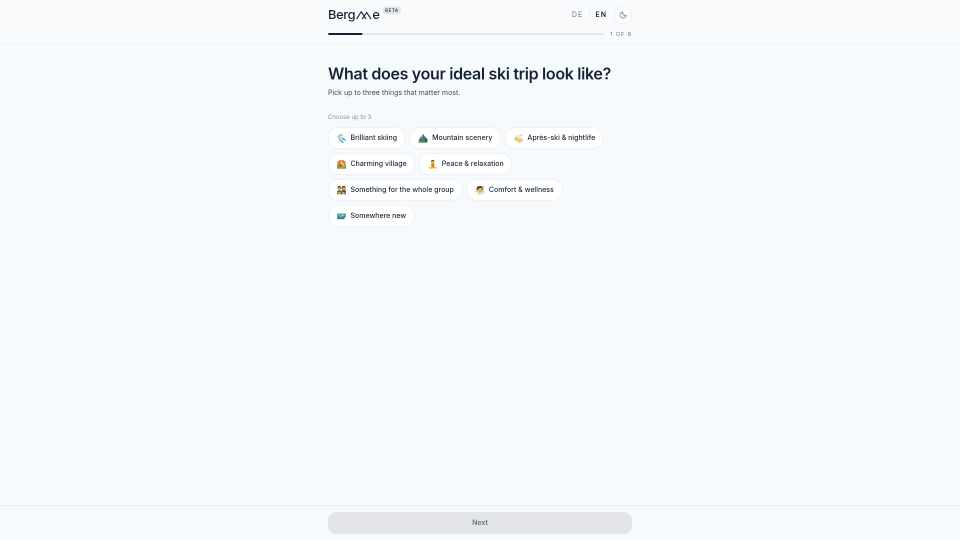
Answer a short set of questions about your travel dates, group size, and skiing preferences, and we match you with ski trips without asking for an account or an email address first. It takes a few minutes and gives you curated options built around how you actually want to ski.
- Tell us your flexible or fixed travel dates so we can flag holiday-week pricing and crowd risk upfront.
- Share your group size and skiing level so we can prioritize resorts with the access points that suit you.
- Browse the hand-picked ski trips we match to your answers and pick the one that fits.
FAQ
What is a level 7 skier?
Most private ski schools use an internal 1 to 9 numeric scale for categorizing skiing ability, and the PSIA Alpine certification standard itself defines three broader zones (Beginner, Intermediate, Advanced). A higher number on a school’s 9-point scale generally falls within the Advanced category.
Which ski resort is the least crowded?
There is no single resort that holds that title, since crowd levels shift by day, storm cycle, and pass-holder activity. Resorts set away from major highway corridors, like Steamboat, tend to see lighter day-trip pressure than corridor resorts, and midweek visits at nearly any resort outside holiday weeks will be your most reliable bet for a quieter day.
What is a level 9 skier?
On the common 1 to 9 private-school scale, a level 9 represents the most advanced classification, typically an expert skier comfortable with steep, variable, or off-piste terrain. The PSIA certification standard places this ability within its Advanced (Level III) category, though PSIA’s own framework does not use the 1 through 9 numbering directly.
What are the different levels in skiing?
PSIA’s certification framework organizes skiing ability into three broad zones: Beginner or Novice (Level I), Intermediate (Level II), and Advanced (Level III). Many private ski schools translate these into a more granular 1 to 9 numeric scale for lesson placement, though the underlying ability groupings are consistent with PSIA’s three-tier structure.