4 September 2026
Decide Fast: Use a Matching Service to Book Ski Resort Transfers
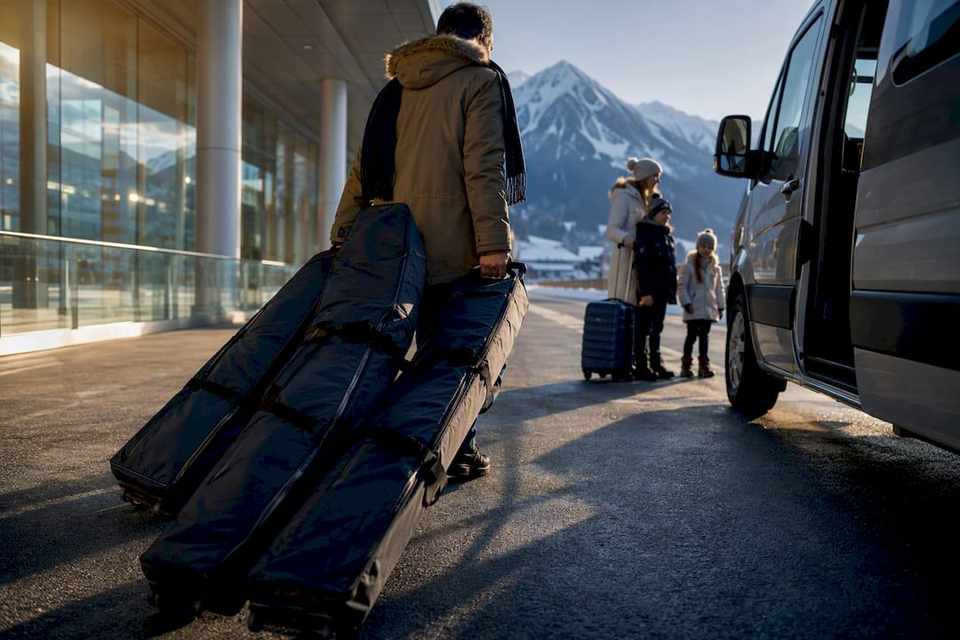
Private transfers work best when speed and door-to-door service matter, shared shuttles fit tight budgets and larger groups willing to make extra stops, and helicopter transfers cover premium or time-critical arrivals to remote resorts. For most travelers, the fastest path to the right choice is comparing two or three licensed operators directly or using a matching service like Bergme, then booking outbound and return transfers together and confirming pickup with your flight number before departure.
TL;DR:
- Private transfers are most cost-effective for families or groups of four or more with multiple ski bags, offering door-to-door service and flight adjustments.
- Booking both outbound and return transfers together, especially during peak seasons or on Saturdays, can secure better availability and pricing.
- Confirm that the provider monitors flights, includes ski equipment transport, and holds valid licensing and insurance to avoid red flags and additional charges.
- Shared shuttles are suitable for solo travelers or budget groups but add considerable travel time and should be avoided if tight schedules or multiple flights are involved.
- Using a ski trip matching service simplifies transfer selection by factoring group size, equipment, and travel dates into a curated package, reducing planning time and mismatched bookings.
Table of Contents
- What Are the Main Types of Ski Resort Transfers?
- How Do You Pick a Reliable Transfer Provider?
- What Does a Ski Resort Transfer Actually Cost?
- What Information Do You Need to Book a Ski Shuttle?
- How Does a Ski-Trip Matching Service Simplify Transfers?
- What Are Standard Cancellation and Refund Terms?
- How Long Does the Full Transfer Take From Landing to Resort?
- Why Booking a Transfer Feels Riskier Than It Should Be
- Book a Ski Trip That Already Handles the Transfer
- Sources
What Are the Main Types of Ski Resort Transfers?
Choosing among ski resort transfers comes down to matching the service to your group size, luggage load, and how much flexibility you can tolerate. Five main categories cover almost every route from major European and North American gateway airports.
Private transfers put one vehicle at your disposal, booked door-to-door with no other passengers. Pricing is set per vehicle rather than per person, which makes them cost-effective for families or groups of four or more traveling with multiple ski bags. Private operators typically include flight monitoring and free ski equipment transport as standard, and the driver adjusts pickup time automatically if your flight lands late.
Shared shuttles run fixed daily departures and combine passengers headed to the same or nearby resorts. They cost less per person but usually add 30 to 90 minutes of extra travel time from multiple hotel drop-offs. Shared shuttles suit solo travelers, couples, and budget-focused groups who aren’t in a rush.
Coaches operate on scheduled routes between major hubs and popular resort clusters, often at the lowest per-person price of any option. Expect a fixed timetable rather than flexible pickup windows.
Taxis and rideshares work for short, last-minute hops but rarely include ski racks or child seats, and per-mile pricing on mountain roads adds up fast over long distances.
Helicopter transfers serve remote resorts or last-minute connections where road time would eat a full day. They’re priced well above ground transport and typically booked directly with specialty operators rather than through general transfer sites.
Quick comparison by group needs:
- Solo or couple, budget priority: shared shuttle or coach.
- Family with ski gear, time-sensitive flight: private transfer.
- Large group (6+) with luggage: private minivan or two coordinated vehicles.
- Remote resort, weather-dependent roads, or very tight connection: helicopter or private 4x4.
Avoid shared shuttles entirely if you have a short layover-style connection between flights and resort check-in, or if your itinerary involves more than one connecting flight. A missed shuttle departure often means waiting for the next scheduled run, sometimes hours later.
How Do You Pick a Reliable Transfer Provider?
The right transfer provider comes down to five checkable facts, not marketing copy. Confirm these before you hand over payment details.
Flight monitoring. A provider that tracks your flight in real time and adjusts pickup automatically saves you the stress of calling ahead when a flight is delayed. This is standard among established private operators.
Vehicle type and door-to-door service. Ask specifically whether the vehicle goes to your resort door or stops at a central drop point, since “door-to-door” gets used loosely in marketing.
Equipment policy. Confirm ski and snowboard bags are included at no extra charge and that you’ve declared exact equipment counts, since some operators plan vehicle size around what’s specified at booking.
Licensing and insurance. Licensed operators with commercial insurance should list this information on their booking page or provide it on request. If they can’t produce it, that’s a red flag on its own.
Cancellation and waiting policies. Know the cutoff for a free cancellation and how long the driver waits at the airport before charging a no-show fee.
Exact questions to ask before booking:
- Is the price per person or per vehicle, and does it change with passenger count?
- What happens if my flight is delayed by more than an hour?
- Is ski equipment transport included, and do I need to declare it in advance?
- What’s your cancellation deadline for a full refund?
- Can you confirm your operator license and insurance coverage in writing?
Red flags include no clear cancellation policy, no phone or email contact beyond a booking form, and reviews mentioning no-shows or drivers who never arrived.
Pro Tip: Call the provider directly and ask about flight delays before booking. How quickly and specifically they answer tells you more about reliability than any star rating.
What Does a Ski Resort Transfer Actually Cost?
Shared shuttle seats generally run cheaper per person than a private vehicle split among the same group, but the math flips once you’re traveling with three or more people and full ski gear. A private vehicle priced per trip often lands close to or below what four shared shuttle seats would cost combined, while cutting travel time significantly.
Distance, season, and how far in advance you book all move the price. Peak changeover days, typically Saturdays during school holidays, carry the highest rates and the tightest availability.
- Distance: longer routes from farther airports naturally cost more, regardless of vehicle type.
- Season: Christmas week, February half-term, and Easter push prices up across every provider.
- Lead time: booking weeks ahead beats booking the morning of arrival, both for price and for guaranteed seats.
Booking outbound and return transfers together at the same time commonly improves seat availability on high-demand changeover days and can produce better combined pricing than booking each leg separately later. Groups traveling over peak weeks should lock both legs at once rather than gambling on availability for the return trip closer to departure.
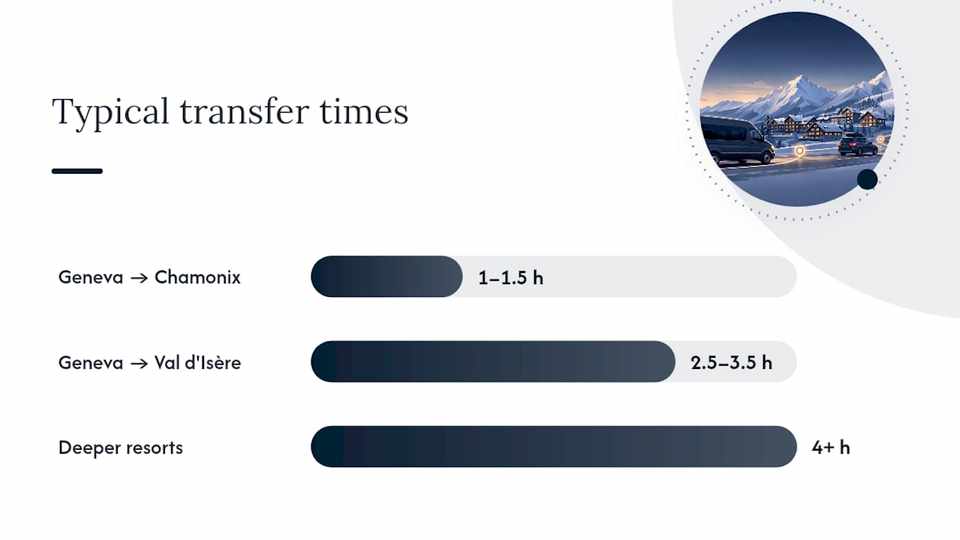
Approximate example routes (illustrative only, subject to season and road conditions): Geneva to Chamonix runs roughly an hour to 90 minutes; Geneva to Val d’Isère typically takes two and a half to three and a half hours; longer routes to resorts deeper in the Alps or Rockies can run four hours or more depending on weather and traffic.
What Information Do You Need to Book a Ski Shuttle?
Have these details ready before you start a booking, whether by form, phone, or email: flight number and arrival terminal, exact resort address (not just the resort name), a working phone contact reachable at your destination, total passenger count, and a precise equipment list covering ski bags, boot bags, and any oversized items.
Many providers run personal quote services by phone or email for unusual routes or last-minute travel dates, so don’t assume every route is available through an instant online form. If your dates are close to travel or your route is nonstandard, calling directly usually gets a faster answer than waiting on a web quote.
Confirm your pickup point 24 to 48 hours before arrival, since some airports use different meeting zones for private transfers than for shared shuttles. If your flight is delayed, contact the provider as soon as you know, even if they claim automatic flight tracking. A quick booking sequence:
- Gather flight number, terminal, resort address, and passenger/equipment count.
- Book outbound and return together if traveling on peak days.
- Confirm pickup point and driver contact 24 to 48 hours out.
- Save the provider’s phone number and reconfirm if your flight schedule changes.
How Does a Ski-Trip Matching Service Simplify Transfers?
Comparing transfer providers one by one across several resorts eats hours most travelers don’t have during trip planning. A ski trip matching service’s questionnaire asks about group size, ski experience, equipment, and travel dates, then matches those answers to specific resort packages that already account for how a group will get from the airport to the door.
That matters most for families juggling car seats and multiple ski bags, or groups splitting across flights who need one coordinated pickup instead of five separate confirmations.
- One set of answers replaces calls to multiple transfer operators.
- Equipment and group size get factored into the package recommendation upfront.
- A single confirmation covers the trip package, reducing the chance of a mismatched vehicle or missed booking window.
- No account or email required to see matched options.
Instead of cross-referencing five provider sites, travelers get a shortlist that already fits how their group actually needs to move.
What Are Standard Cancellation and Refund Terms?
Cancellation policies vary by provider, but most licensed operators publish a clear cutoff, commonly somewhere between 24 and 72 hours before pickup, for a full refund. Cancel after that window and you’ll typically forfeit part or all of the fare, since the vehicle and driver were already allocated to your trip.
Waiting time policies matter just as much as cancellation terms. Reputable providers state exactly how long a driver waits at the airport, often 60 to 90 minutes for international arrivals, before charging a no-show or late fee. This protects you if your flight lands late but also protects the operator when a passenger simply doesn’t show up.
Always get the cancellation and waiting policy in writing, whether that’s a confirmation email or a line item on the booking page, before you pay a deposit. If a provider’s site doesn’t mention either policy, ask directly. A provider unwilling to specify a waiting time or refund cutoff in writing is a red flag on its own, not just an inconvenience.
For group bookings, check whether the policy applies per passenger or per vehicle. Some providers allow partial cancellations, letting you drop two seats from a six-person shuttle without forfeiting the entire booking, while others treat the reservation as all-or-nothing.
How Long Does the Full Transfer Take From Landing to Resort?
The total timeline from touchdown to your resort door breaks into four stages, and knowing them helps you set realistic expectations rather than standing at the curb wondering where your driver is.
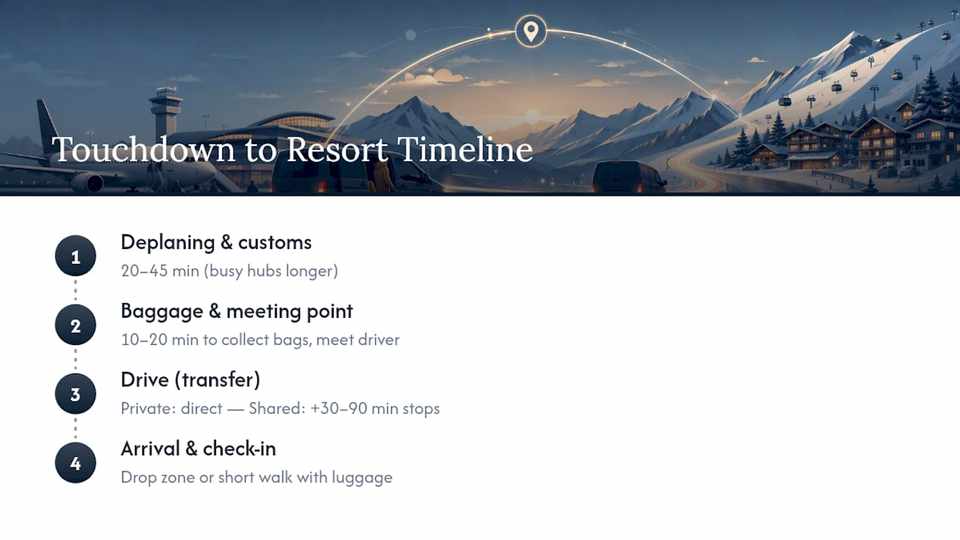
Stage one: deplaning and customs. Budget 20 to 45 minutes depending on the airport and whether you’re clearing customs or just baggage claim. International arrivals at busy hubs run longer during peak ski season.
Stage two: baggage and meeting point. Add another 10 to 20 minutes to collect ski bags and locate your driver or shuttle desk, which is why confirming the exact meeting point in advance saves real time on arrival day.
Stage three: the drive itself. This is where transfer type matters most. A private vehicle goes straight to your resort with no stops. A shared shuttle may add 30 to 90 minutes for other passenger drop-offs along the route.
Stage four: arrival and check-in. Most resorts have marked drop zones near hotel entrances or lift bases, though some village centers restrict vehicle access and require a short walk with luggage.
Total time from landing to slope-side check-in typically runs somewhere between two and six hours depending on route length, transfer type, and how many stops a shared service makes. Building in a buffer of an extra hour beyond the driver’s stated time avoids the stress of a tight afternoon lift-pass pickup deadline.
Why Booking a Transfer Feels Riskier Than It Should Be
Most guides treat ski resort transfers like a commodity, telling you to compare three quotes and pick the cheapest. That advice misses the actual failure point: it’s not price that ruins a transfer, it’s mismatched expectations about stops, equipment space, and what happens when a flight runs late.
The conventional advice also underweights timing. Booking your return leg separately, weeks after you’ve locked the outbound trip, is the single most avoidable mistake in this category. Peak changeover Saturdays sell out vehicles fast, and travelers who assume they can sort the return later often end up paying more or scrambling for a seat.
What actually matters is narrower than most checklists suggest: confirm the cancellation window, confirm equipment is declared, and book both legs together. Everything else is secondary. A matching service that already factors group size and gear into a transfer-inclusive package removes most of that risk before you’ve made a single phone call, which is exactly the gap conventional “compare five sites” advice leaves open.
Book a Ski Trip That Already Handles the Transfer
There are services that offer an alternative to hunting through separate transfer sites, resort booking pages, and shuttle timetables one by one. Answer a short questionnaire about your group, gear, and dates, and these services match you to curated ski packages that factor transfer needs into the recommendation instead of leaving you to sort it out after booking a hotel.

The current New Year Ski Holiday in Interlaken package pairs a stay at Hotel Bären with a ski pass, structured around peak-season travel dates when transfer availability runs tightest. Start the Bergme questionnaire now to see matched packages for your group size and travel window, no account or email required.