29 October 2026
Summer Skiing Resorts: Where You Can Still Ski in Summer

Summer skiing exists in two forms. The first is high-elevation glacier skiing in the Northern Hemisphere, found mainly in the Alps, with a small North American option at Timberline on Oregon’s Mount Hood. The second is regular winter skiing in the Southern Hemisphere, in Chile, Argentina, New Zealand and Australia, where the season runs roughly from June to October. This guide covers both, with operating patterns, access limits and a way to decide between them.
TL;DR
- Northern Hemisphere summer skiing is limited to glaciers and a few high lifts: Zermatt and Saas-Fee in Switzerland, Hintertux in Austria, Tignes in France, and Timberline in Oregon.
- Glacier skiing in summer is usually a morning activity on a limited number of pistes. Expect up to 21 km at Zermatt, with lifts to the ski area timed for early hours.
- For full-scale winter conditions in July and August, the Southern Hemisphere is the dependable choice: Valle Nevado, Las Leñas, Cerro Catedral, Coronet Peak, Treble Cone, Perisher and Thredbo.
- Whistler Blackcomb has indefinitely closed its summer skiing because of glacial recession, so North American options are few.
- Always confirm dates and snow conditions on the resort’s official page before booking, as summer operation depends on the snowpack.
Table of Contents
- How summer skiing works
- Summer skiing in the Alps
- Summer skiing in North America
- Southern Hemisphere: full ski days in June to October
- Choosing between the options
- What to check before booking
- Our perspective
- Finding the right trip with BergMe
- FAQ
- Sources
How summer skiing works
Skiing in June, July or August depends on snow that survives the warm season. In the Northern Hemisphere that means glaciers at high altitude, where lifts reach terrain that stays snow-covered after the valleys turn green. In the Southern Hemisphere the calendar does the work: OnTheSnow’s 2026 guide describes the season there as running broadly from June through October.
The two types differ in almost every practical respect:
| Factor | Northern glacier skiing | Southern Hemisphere resorts |
|---|---|---|
| Terrain | A limited set of glacier pistes | Full resort terrain, with lifts, trails and villages |
| Hours | Often morning only | Standard full ski days |
| Snow reliability | Depends on the glacier and the weather | Winter snowpack, generally from June |
| Travel | Short trip from Europe, with a stay in an Alpine village | Long-haul flights for most travelers from the US and Europe |
| Best for | Training, a short snow fix, combining skiing with hiking | A complete ski holiday |
Summer skiing in the Alps
The Alps offer the largest concentration of Northern Hemisphere summer skiing. The glacier areas sit high enough that snow cover remains into July or beyond, and some open through much of the year.
Hintertux Glacier, Austria
Hintertux, in the Zillertal Alps, is one of the few ski areas open year-round according to OnTheSnow, which says about 20 kilometers of terrain may operate in summer. The resort’s own ticket page states that skiing runs from around the beginning of October to around mid-July, as soon as snow conditions permit, and that the pedestrian access road is open 365 days a year.
The 2026/27 panoramic return ticket to Gefrorene Wand costs €56 for adults and €34 for children. That ticket suits visitors who want to reach the glacier on foot or on the lifts without skiing a full day.
Hintertux also sells a Tux³ ticket for summer 2026. It includes one ascent and descent on the glacier plus the Eggalm and Finkenberg lifts, and it is valid for three days within a six-day window. It is a reasonable option for a group where some people ski and others prefer mountain playgrounds and attractions.

Zermatt and the Theodul Glacier, Switzerland
Above Zermatt, the summer ski area on the Theodul Glacier offers up to 21 km of pistes, according to the Zermatt Bergbahnen summer pass page. Skiing generally runs until midday. The area includes a Summer Snow Park on Plateau Rosa, and a free local bus runs to the Matterhorn-Express valley station.
Pass structure matters when choosing length of stay:
- One- and two-day summer ski passes include the summer ski area and the Matterhorn Glacier Paradise facilities according to the timetable.
- Passes of three or more days also include Sunnegga–Rothorn services and bike transport, which helps if the plan mixes skiing with riding or hiking in the afternoons.
The early finish has a practical consequence. The official summer timetable shows that in summer 2026 the last mountain ascent for snow sport enthusiasts was restricted to 10:00 AM on certain dates, while lift hours for general summer tourism varied by sector. Visitors planning to ski should therefore count on an early start and check the current timetable for the travel dates.
Travelers who want a fully bespoke Zermatt itinerary, with accommodation and glacier activities arranged together, can look at luxury ski trip planning for a more tailored approach.
Saas-Fee, Switzerland
Saas-Fee typically offers about 20 kilometers of summer skiing from mid-July into autumn, according to OnTheSnow. That timing makes it a good fit for late-summer trips, after some other glacier areas have reduced operations.
Tignes, France
Tignes generally runs its Grande Motte glacier into July, subject to snow conditions, per the same OnTheSnow guide. It suits early-summer trips in June and early July more than August visits.
Norway’s Fonna Glacier
Summer skiing also exists beyond the Alps. PowderGuide reported that in 2019, Fonna Glacier’s summer ski season ran from May 14 to September 30. That is a historical season, and the current one should be confirmed locally, but it shows that Scandinavian glaciers can extend well into the warm months.
Summer skiing in North America
Options are limited and shrinking. Timberline Lodge on Oregon’s Mount Hood offers lift-accessed summer skiing and snowboarding on Palmer Snowfield, generally from June through August. Its official page said the 2026 summer season had concluded when it was checked, which illustrates how the season ends when the snow does. OnTheSnow notes that Timberline typically operates from around late May or June into August.
SnowSeekers reports that Whistler Blackcomb indefinitely closed its summer skiing from summer 2025 because of glacial recession, and describes Timberline as having North America’s longest ski season. The closure is a reminder that glacier-dependent operations can change from year to year.
Some large resorts, including Mammoth Mountain in California, run summer programs without skiing. Mammoth’s homepage lists 3,500+ skiable acres, 25 lifts and 181 trails for winter, plus 80+ miles of single track, 52 bike trails and seven hiking trails for the warmer months. Summer there means biking and hiking rather than turns on snow.

Southern Hemisphere: full ski days in June to October
Travelers who want normal ski conditions during the northern summer generally look south. The New York Times highlights Chile’s Valle Nevado and Argentina’s Las Leñas and Cerro Catedral as options for dependable winter-like skiing, with the season generally running from June into September or October.
South America
- Valle Nevado, Chile: high-altitude terrain close to Santiago.
- Las Leñas, Argentina: a destination resort known for its advanced terrain.
- Cerro Catedral, Argentina: a large ski area near Bariloche.
New Zealand and Australia
OnTheSnow lists Coronet Peak and Treble Cone in New Zealand, and Perisher and Thredbo in Australia. In its description, Coronet Peak has beginner-to-intermediate terrain, while Treble Cone offers stronger freeride and advanced terrain. That split is useful when a group has mixed ability levels.
Choosing between the options
Five criteria decide most summer ski trips:
- Purpose. A short snow fix or a training block favors a glacier. A full holiday favors the Southern Hemisphere.
- Timing. Early summer (June and early July) works for Tignes and Timberline. Mid-July onward favors Saas-Fee, Hintertux and Zermatt. The Southern Hemisphere peaks from roughly July to September.
- Ability. Glacier terrain is limited. Advanced skiers wanting variety are better served by a southern resort with a full lift network.
- Group makeup. Mixed groups benefit from places with non-ski activities, such as Zermatt’s multi-day passes or Hintertux’s Tux³ ticket.
- Budget and travel time. Alpine glaciers add little flight time for European visitors. For US travelers, Timberline is the shortest trip but the least certain.
What to check before booking
- Operating dates. Summer seasons are conditional. Hintertux’s page says skiing runs as soon as snow conditions permit, and Tignes operates subject to snow.
- Daily hours. Zermatt’s pistes are generally open until midday, and restrictions on the last ascent applied on certain dates in 2026.
- Pass inclusions. Compare what each ticket covers, such as lift access beyond the glacier, bike transport or valley services.
- Season ending. Timberline’s and Mammoth’s own pages showed their summer lineups had finished by the time of checking, so rely on the official page for current status.
- Glacier recession. Whistler Blackcomb’s closure shows that a resort offering summer skiing one year may not do so the next.
Our perspective
We see summer skiing questions from two very different groups. One wants a few hours on snow as part of an Alpine trip, and the other wants a complete ski holiday while it is warm at home. The first group is usually well served by a glacier like Zermatt or Hintertux, provided expectations match the reality of a short, early-morning ski day. The second group should plan around a Southern Hemisphere resort and treat the glaciers as a bonus rather than the main event.
The common mistake is treating all summer skiing as one product. A glacier day and a Chilean ski week differ in terrain, cost structure and risk. That is why we start from group composition, ability and what each person wants from the trip, then filter mismatches before ranking resorts. A group of friends with one beginner and two experts needs a different answer from a couple wanting a quiet mountain stay with one morning on snow.
— Eduard
Finding the right trip with BergMe
BergMe matches skiers, families, couples and groups with ski trips through a short questionnaire that covers riding style, group dynamics and preferences. It requires no registration and no email address, and it returns specific resorts and packages rather than a general list.
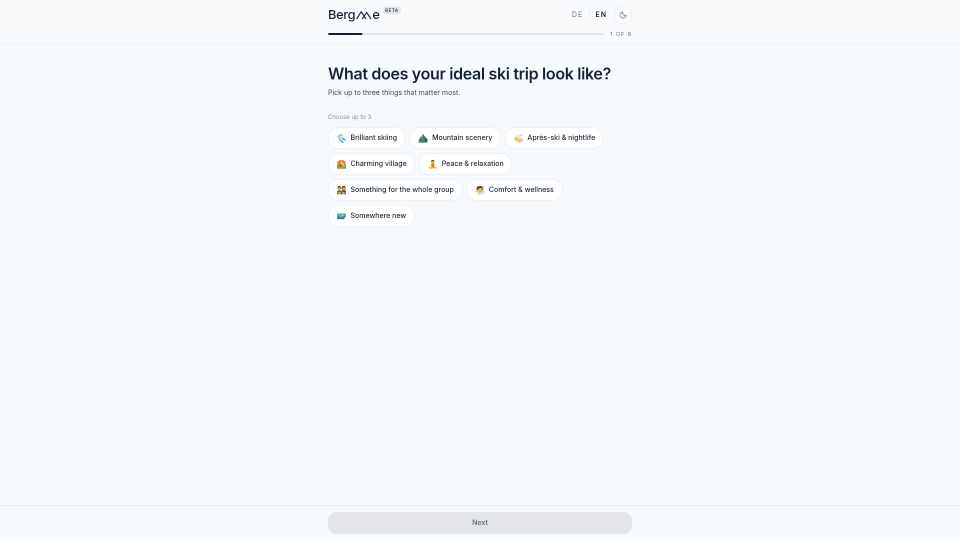
For travelers deciding when and where to ski, the questionnaire at BergMe’s hand-picked ski trips is a quick way to narrow the options. Those thinking about the coming winter instead of summer can also see an example such as the New Year ski holiday in Interlaken with a ski pass.
FAQ
Where can you ski in the summer?
The main places are Alpine glaciers such as Zermatt, Saas-Fee, Hintertux and Tignes, Timberline in Oregon, and Southern Hemisphere resorts in Chile, Argentina, New Zealand and Australia. Glaciers offer limited terrain, while the southern resorts operate as regular winter ski areas from about June to October.
Is there year-round skiing in Europe?
Hintertux in Austria is described by OnTheSnow as one of the few ski areas open year-round. Its own page gives the skiing window as around the beginning of October to around mid-July, as soon as snow conditions permit, so the exact operation depends on conditions in a given year.
What time of day is summer skiing at Zermatt?
The Theodul Glacier summer ski area generally operates until midday. Zermatt’s 2026 timetable also showed that the last mountain ascent for snow sport enthusiasts was restricted to 10:00 AM on certain dates, so early starts are the norm.
Can you still ski in summer in North America?
Yes, but options are narrow. Timberline Lodge on Mount Hood offers lift-accessed skiing on Palmer Snowfield, generally from June through August. Whistler Blackcomb has indefinitely closed its summer skiing because of glacial recession.
Sources
- Where to Ski Around the World in Summer, OnTheSnow
- Ski resorts with summer operation, PowderGuide
- Ticket prices Hintertuxer Gletscher
- Tux³ flexible 3-mountain ticket
- Ski pass summer, Zermatt Bergbahnen
- Timetable summer 2026, Zermatt Bergbahnen
- Summer ski and snowboard, Timberline Lodge
- Places you can go summer skiing, SnowSeekers
- Looking for a summer ski fix? Head to South America, The New York Times
- Mammoth Mountain
- Luxury heli-skiing trip planning, Hidden Door Travel